AI News
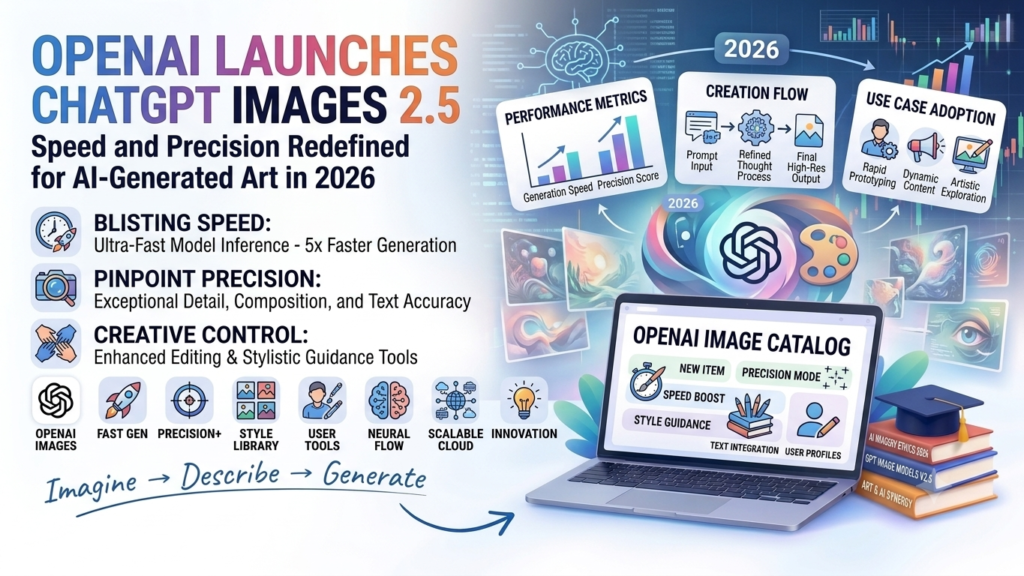
OpenAI Launches ChatGPT Images 2.5 : OpenAI has launched ChatGPT Images 2.5, introducing new AI image generation capabilities focused on faster creation and greater visual precision. Here’s what the update means for creators, developers, businesses, and the future of AI image generation.
From basic text-to-image experiments to sophisticated creative workflows, artificial intelligence picture production is advancing quickly. The most recent ChatGPT Images 2.5 release, which gives customers more control over how quickly images are made and how correctly visual instructions are followed, indicates an important path for the industry. OpenAI has continued to expand its capabilities in this area.
AI image production is now more than just creating visually appealing images for creators, marketers, designers, developers, and companies. AI technologies are expected by users to comprehend intricate instructions, be consistent, adhere to particular visual specifications, and generate useful outcomes fast. The most recent version illustrates how AI image production is getting more specialized and reflects this shifting need.
A new generation of AI-powered image creation called ChatGPT Images 2.5 is intended to improve image generating’s utility across various processes. The new method stresses varied priorities based on user needs rather than handling every image-generation request in the same way.
Some consumers want an image to be produced as soon as feasible. If the outcome more closely complies with their instructions, others might be prepared to wait longer.
As AI-generated photos become more prevalent in professional settings, this distinction becomes more crucial. While an advertising firm might be more concerned with precise composition, branding, typography, and visual aspects, a social media producer might place a higher priority on quickness.
The biggest change happening in AI image generation is the transition from experimentation to everyday use.
A few years ago, people mainly used AI image generators to experiment with unusual artwork, fantasy scenes, portraits, and creative concepts. Today, businesses use AI-generated visuals for marketing campaigns, blog articles, social media posts, product concepts, presentations, advertisements, and educational content.
This means image-generation models have to solve more complicated problems.
A professional user might request a specific subject, background, camera angle, lighting setup, brand style, text placement, aspect ratio, and composition in a single prompt.
The quality of an AI image generator is therefore increasingly measured by how well it follows instructions, not simply by how realistic the final image looks.
One of the most important priorities in modern AI applications is speed.
Users have become accustomed to receiving AI-generated text almost instantly. Image generation traditionally takes longer because producing a detailed image requires significantly more computational processing.
For people generating multiple images, even small improvements in generation speed can make a meaningful difference.
Consider a social media manager who needs ten images for a campaign. Faster generation allows the person to experiment with more ideas, reject poor results, and produce final assets within a shorter period.
The same applies to designers working on concepts. Instead of spending significant time waiting for each generation, faster AI can support a more iterative creative process.
Speed is valuable, but accuracy remains one of the biggest challenges in AI image generation.
Users often have a very specific idea in mind. They may want a person standing on a particular side of an image, a product positioned in a specific location, certain objects included in the background, or a particular visual style.
When an AI model fails to follow those instructions, users have to regenerate the image repeatedly.
Better prompt understanding can reduce this problem.
Precision-focused image generation can be especially useful for professional applications where visual requirements are strict. Advertising, product marketing, educational graphics, and branded content all require greater control than casual image generation.
AI-generated images are increasingly becoming part of business workflows.
Marketing teams can use AI to create campaign concepts.
Content teams can generate featured images for articles.
Recruiters can create visuals for hiring campaigns.
Startups can develop early product concepts.
E-commerce businesses can experiment with promotional imagery.
Small businesses can produce marketing graphics without hiring a professional designer for every piece of content.
This does not necessarily mean AI will replace designers. Instead, AI can reduce the time required to produce initial concepts and repetitive visual assets.
A designer can spend less time creating basic variations and more time focusing on creative direction, brand consistency, and final production.
The amount of visual content produced online continues to increase.
Every blog article, social media campaign, video, advertisement, and presentation can require multiple visual assets.
Traditionally, producing these images could involve stock-photo searches, graphic design software, photography, freelancers, or agencies.
AI image generation provides another option.
A content creator can describe an image using natural language and receive a visual concept within a short period. The creator can then modify the prompt and generate additional versions.
This creates a new workflow:
Idea → Prompt → Image → Feedback → Regeneration → Final Asset
The process can be significantly faster than traditional production for many types of content.
Early text-to-image systems were primarily focused on converting a written description into an image.
Modern systems are expected to understand much more.
Users want AI to interpret complex instructions involving:
This makes prompt understanding a critical part of image-generation technology.
As models improve, users may also need to spend less time learning complicated prompting techniques.
Instead of writing highly technical prompts, people can increasingly describe what they want naturally and allow the AI system to interpret the instructions.
There is no single definition of the “best” image generator.
Different users prioritize different capabilities.
Content creators often prioritize speed and the ability to produce multiple visual variations quickly.
Designers may prioritize precision, consistency, composition, and control.
Marketing teams may require brand consistency and commercially useful visuals.
Developers may care about API availability, scalability, latency, and integration.
Businesses often need predictable results, reliability, and the ability to generate content repeatedly.
This is why specialized approaches to image generation are becoming increasingly useful.
AI image generation is not limited to consumer-facing chat interfaces.
Developers can integrate image-generation capabilities into their own applications.
This could lead to new products in areas such as:
For example, an e-commerce platform could potentially allow sellers to create promotional product imagery automatically.
A marketing platform could generate campaign visuals based on a written brief.
An education platform could create customized illustrations for learning materials.
The API ecosystem therefore has the potential to become as important as the consumer image-generation experience itself.
As AI models become faster and more capable, image generation is becoming accessible to a much larger audience.
People do not necessarily need professional graphic-design skills to create an initial visual concept.
A student can create illustrations for a presentation.
A small business owner can generate promotional concepts.
A blogger can create a featured image.
A startup founder can visualize a product idea.
A social media manager can experiment with campaign concepts.
This democratization of visual creation is one of the most important effects of generative AI.
The technology gives more people the ability to turn an idea into a visual without requiring advanced design software knowledge.
Despite rapid improvements in AI image generation, human creativity remains important.
AI can generate images, but people still need to decide:
Generating an image is not the same as creating effective visual communication.
The strongest workflows will likely combine AI generation with human creative direction.
AI can handle much of the repetitive production process while humans remain responsible for strategy, taste, storytelling, and final decisions.
The next stage of AI image generation may not simply be about producing increasingly realistic images.
The bigger goal is likely to be greater control.
Users will expect AI systems to understand exactly what they mean and make precise changes without unnecessarily changing other parts of an image.
For example, a user might want to change only the background while keeping the subject, clothing, lighting, and composition unchanged.
Another user might want to modify a product’s color while preserving its shape and branding.
This kind of controllable image generation could make AI much more useful for professional creative work.
ChatGPT Images 2.5 refers to a newer generation of AI-powered image-generation capabilities designed to improve the speed, precision, and usefulness of AI-generated visuals.
Faster image generation allows creators and businesses to produce more visual variations, experiment with ideas, and complete content-production workflows more efficiently.
Businesses can use AI-generated visuals for marketing concepts, social media content, blog graphics, advertisements, product concepts, presentations, and other creative workflows.
AI image generators are more likely to change the role of designers than completely replace them. Human creativity, brand strategy, visual judgment, and creative direction remain important.