
AI News
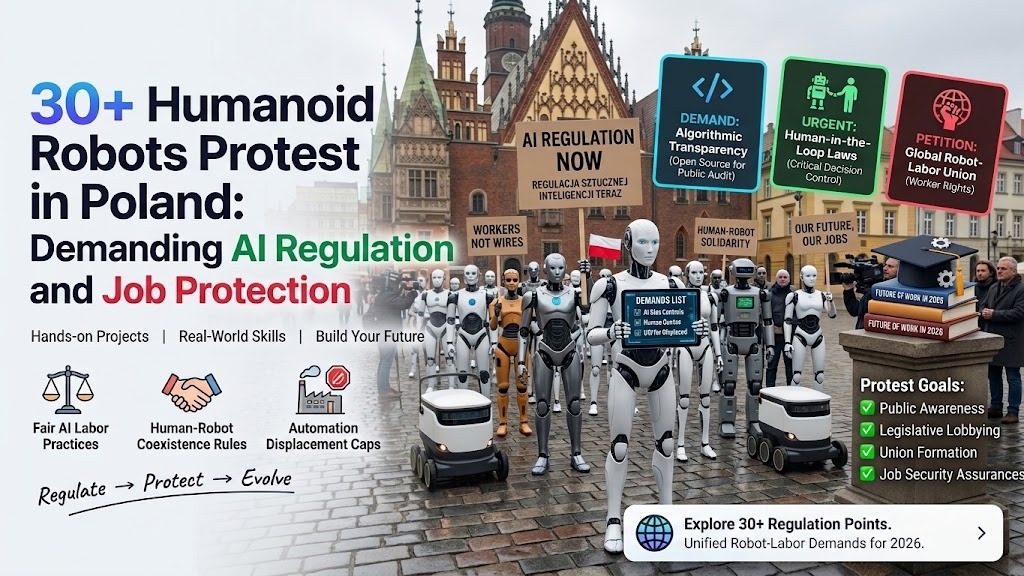
Around 30 Robots Protest in Poland: Around 30 humanoid and robotic dogs demonstrated outside Poland’s Ministry of Digital Affairs in Warsaw, calling for stronger AI regulation and protection of human jobs. Here’s what the unusual robot protest means for the future of work.
Imagine seeing some thirty humanoid robots and robotic canines gathered before a government ministry in Warsaw. They would be waving flags, moving about, and transmitting slogans like “Don’t wait, regulate” and “Defend workplaces.” On September 7, 2026, robots participated in a demonstration outside Poland’s Ministry of Digital Affairs, making that strange image a reality. The purpose of the event was to raise awareness of the increasing effects of automation, robots, and artificial intelligence on the labor market.
The protest was organized by democratism, an endeavor to encourage public discourse about robotization, artificial intelligence, and their potential impact on employment. Despite headlines depicting the event as robots “protesting,” human organizers were using and operating the devices. Their existence was intentionally symbolic since the technology that could eventually automate human labor was being used to alert society to the consequences of such shift.
Around 30 robots gathered outside Poland’s Ministry of Digital Affairs on September 7. The machines included humanoid robots as well as four-legged robotic systems resembling dogs. They waved flags, moved around the demonstration area and broadcast messages calling for stronger AI rules and protection for workplaces.
Among the robots was an Agibot A3, an AI-powered humanoid robot that interacted with journalists. The demonstration was intended to show that humanoid robotics is no longer simply a futuristic concept. These machines are already capable of moving through physical environments and interacting with people, even though their capabilities remain far from the science-fiction image of fully autonomous robots.
The main takeaway from the Warsaw protest was not that robots themselves desired job rights. The event was planned by humans to draw attention to worries about how automation and artificial intelligence can impact human jobs.
Grzegorz Kuliś, the campaign’s organizer, stated that the campaign was especially worried about humanoid robots and AI systems replacing humans in cognitive tasks. Governments should set regulations before technology advances more quickly than society can adapt, according to the organizers.
Automation in factories is not the only issue here. Manufacturing has already been revolutionized by traditional industrial robots, but contemporary AI offers an alternative: software can increasingly carry out knowledge worker-related jobs. Automation is becoming more prevalent in writing, coding, customer service, research, data analysis, and administrative tasks.
Compared to a traditional policy demonstration, the protest was far more apparent due to the uncommon usage of robots.
The machines themselves become part of the message, rather than individuals carrying banners cautioning against automation. The technologies that could increasingly enter workplaces and carry out duties traditionally performed by humans were represented by humanoid and quadruped robots.
There was a clear irony in that. Robots were being utilized to alert people about the potential replacement of human workers by robots. In essence, the organizers were urging legislators to consider the implications of the technology while also showcasing it.
The fact that the robots did not choose to protest on their own is among the most crucial aspects of the narrative.
Through the Democratism campaign, people organized the protest. The organized event included chants that called for the introduction of AI regulations and the defense of workplaces. Additionally, some state that loudspeakers were used to play the messages.
This distinction is important because headlines about “robots protesting” might easily give the idea that humanoid robots have organized themselves or formed their own political opinions.
That is not the case.
The true story is perhaps more intriguing: people are already able to deploy increasingly complex robots into public areas and use them to convey social and political messages about automation’s future.
Poland’s Minister of Digital Affairs, Krzysztof Gawkowski, was drawn to the protest and met Grzegorz Kuliś, the organizer, there.
Uncontrolled AI models included into humanoid robots, which are anticipated to grow in capability as robotization progresses, are a significant worry, according to Gawkowski. His answer demonstrates how the conversation is shifting from tech firms and scholars to public policy.
Poland has also been developing national AI oversight systems, according to Euronews. The nation enacted laws putting the EU AI Act framework into effect, establishing a national body that could enforce the pertinent regulations.
This indicates that the Warsaw protest was held in opposition to a broader European discussion about how governments should control artificial intelligence while permitting innovation.
Historically, factories, warehouses, and other physical workplaces have been the focus of the concern surrounding robots.
Because of their physical characteristics, humanoid robots may be able to function in settings intended for humans, which might broaden that conversation.
Simultaneously, AI software is becoming more capable of handling cognitive activities. As a result, both digital and physical automation are produced.
Thus, in a future workplace, AI systems may manage planning, communication, analysis, and decision-making support while robots perform physical duties.
This does not imply that all jobs will vanish. Technology is much more likely to alter a job’s obligations than to completely eradicate it.
The most important question may not be whether AI and robotics will change employment. They almost certainly will.
The bigger question is how quickly those changes happen and whether workers have enough time and support to adapt.
If companies introduce automation rapidly, some workers could find that their existing skills are no longer as valuable. Governments, universities, employers and training platforms may therefore need to place greater emphasis on reskilling and upskilling.
Workers could increasingly need skills that complement AI rather than compete directly with it.
These could include AI literacy, communication, problem-solving, domain expertise, critical thinking and the ability to work effectively with automated systems.
AI legislation is frequently debated in terms of safety, copyright, cybersecurity, privacy, and disinformation.
Another significant aspect is added by the Warsaw demonstration: employment.
Governments may have to think about how current labor laws apply to more automated workplaces if AI systems and humanoid robots are able to carry out more duties.
Who is in charge when an AI-powered robot makes a mistake, how businesses should disclose workplace automation, what forms of monitoring are appropriate, and whether employees should have rights regarding automated decision-making are just a few such questions.
As AI transitions from software interfaces to real settings, these problems will probably become more crucial.
The timing of the demonstration might be its most potent feature.
The field of humanoid robotics is growing quickly, and at the same time, generative AI is improving. Eventually, these technologies might come together.
Advanced AI may enable a robot to comprehend commands, navigate a space, communicate with humans, and carry out manual labor.
Compared to previous industrial robots, this combination may significantly increase automation’s flexibility.
Therefore, the Warsaw demonstration begs a more general question: Are governments ready for a future in which AI is physically present in workplaces rather than simply within computers and smartphones?
The incident should not be seen by workers as a sign that millions of people will soon be replaced by humanoid robots.
Cost, dependability, energy consumption, safety, and the problem of carrying out intricate physical tasks in uncertain surroundings are just a few of the major obstacles that the technology still has to overcome.
The example does, however, draw attention to a real problem: employees must get ready for technological change before it occurs on a broad scale.
It may become more crucial for career planning to grasp how AI technologies operate and how automation is altering particular industries.
It could not be just humans battling robots in the workplace of the future.
It’s possible that people will collaborate with robots and AI systems, giving workers who are proficient with these tools a competitive edge.
The Warsaw demonstration may appear strange, even amusing, but there is a severe problem at its core.
Robotics is rapidly integrating AI intelligence with physical machines, and AI development is proceeding swiftly.
Whether or if these technologies are feasible is no longer the only question.
It concerns how society ought to present them.
Businesses in the technology sector want to innovate. Companies desire to be more productive. Both economic expansion and technological competitiveness are desired by governments. Employees desire fair treatment and secure employment.
All four must be balanced for an AI economy to be sustainable.
This tension is captured in a single scene by the peculiar picture of robots demonstrating outside a government ministry.
The technology was symbolized by the machines.
The workers who might potentially be impacted by the demonstration were represented by the people behind it.
The robot demonstration that took place in Warsaw on September 7, 2026, was true, but it’s crucial to comprehend what really took place. As part of a human-organized protest advocating for stricter AI legislation and worker protections, over thirty humanoid and quadruped robots made an appearance outside Poland’s Ministry of Digital Affairs. Democratism organized the event to promote conversation regarding robotization, artificial intelligence, and the job market.
A political demonstration was not independently organized by the robots. Rather, people purposefully employed robots as a potent metaphor for the technological shifts they feel society and governments must undertake.
That distinction makes the story even more relevant.
Robots alone are unlikely to decide the nature of labor in the future. Decisions taken by governments, corporations, employees, and IT developers will influence it.
The emphasis should be on more than just what machines can do as AI systems and humanoid robots become more sophisticated.
It should also focus on how people can adapt, which jobs can change, what safeguards employees need, and what regulations should be in place for more autonomous technology.
Even if the robots in Warsaw were performing in loops, the question they assisted in posing to decision-makers is traveling straight ahead:
How can we help people benefit from technological advancement?
Yes. Around 30 humanoid and quadruped robots appeared at a demonstration outside Poland’s Ministry of Digital Affairs in Warsaw on September 7, 2026. However, the event was organised by humans rather than by autonomous robots.
The demonstration was organised to raise awareness about the potential impact of artificial intelligence and robotisation on the labour market and to call for stronger regulation and protections for human workers.
No. The robots were being used as a symbol of automation. The campaign was focused on the potential effects of AI and robotics on human employment, rather than robot rights.
The demonstration was organised by Democratism, an initiative focused on encouraging debate about how AI and robotisation could affect the labour market.