
AI News
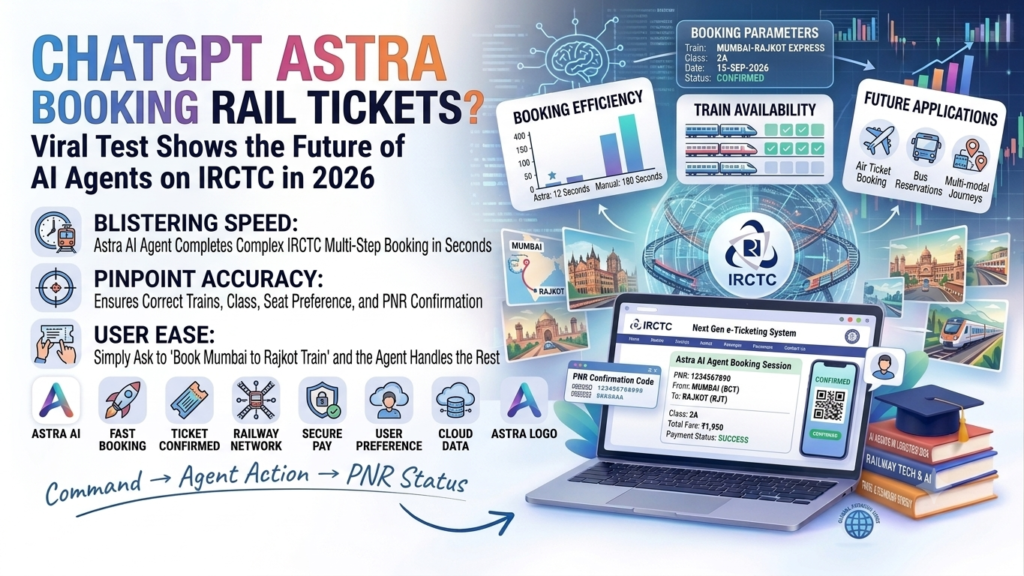
ChatGPT Astra Books Train Ticket on IRCTC : A viral test shows ChatGPT Astra navigating IRCTC to search for a Mumbai to Rajkot train, check availability and fill booking details with minimal human input. Here’s what the AI agent demonstration means for the future of automation.
Imagine giving an AI assistant the command, “Book a train ticket from Mumbai to Rajkot,” and seeing it launch a website, input your travel information, look up available trains, verify ticket availability, and complete the booking form by itself.
A recent viral demonstration tried to demonstrate just that. In order to test OpenAI’s GPT-6 Astra, a social media creator asked it to locate a train in AC class for two persons from Mumbai to Rajkot. The author claims that Astra found trains that met the specifications, navigated the IRCTC website, and completed the booking procedure with little assistance from a human.
The demonstration has garnered interest because it illustrates how AI agents could do more than just respond to inquiries. An AI agent might be able to handle many of the procedures needed to book a rail ticket instead of instructing people on how to do so. The author said that payment was the last stage, hence the demonstration did not depict a totally autonomous transaction.
The question of whether ChatGPT Astra could truly purchase a train ticket through IRCTC, India’s official railroad ticketing portal, is said to have sparked the viral experiment.
The creator made the decision to put the capability to the test. He launched ChatGPT Astra and gave it a simple command: use the browser to locate a train for two individuals traveling in AC class from Mumbai to Rajkot on September 20 between 9 and 11 p.m.
Astra then navigated the booking procedure, chose the departure and destination stations, entered the preferred travel date and time, looked for available trains, and verified the availability of various alternatives, according to the presentation provided by Moneycontrol. The developer told the AI to look for options the next day after discovering that the available selections were on the waiting list.
According to the developer, the only thing left for him to do was make the payment once the AI finished the processes of searching, choosing, and filling out the form. When summarizing what the demonstration truly demonstrated, this distinction is crucial.
The demonstration’s primary value is that it illustrates the distinction between an AI agent and a conventional chatbot.
A traditional chatbot answers a query. The chatbot may offer guidance on how to use IRCTC if someone asks, “How can I book a train from Mumbai to Rajkot?”
An AI agent might be able to do more.
It can comprehend the user’s objective, navigate through a multi-step workflow, access a website, interact with buttons and forms, collect data, and make decisions depending on the user’s instructions.
As a result, the exchange shifts from “explain me how to do it” to “perform the task for me.”
IRCTC is a particularly interesting environment for testing AI agents because train booking involves multiple steps.
A user generally has to enter the source station, destination, travel date and other preferences before searching for available trains. The user then needs to compare options, check availability and continue through the booking process.
According to the viral demonstration, Astra was able to perform several of these browser interactions after receiving a relatively simple natural-language instruction.
The important point is not simply that an AI can type information into a website.
The important development is the ability to connect natural-language instructions with real-world digital actions.
This is perhaps the most important clarification for anyone writing about the viral video.
The headline may suggest that ChatGPT Astra completely booked a train ticket. However, the report says that the creator still had to make the payment.
Therefore, it is more accurate to say that Astra navigated and progressed through the IRCTC booking workflow, rather than claiming that it independently purchased the ticket from start to finish.
This distinction matters because payment is one of the most sensitive parts of any online transaction.
Users need to retain control over financial transactions, payment confirmation and other consequential actions.
The train-ticket experiment demonstrates a broader change happening across artificial intelligence.
Generative AI originally became popular because it could generate text, images and code. The next major development is AI that can take actions.
An agent can combine several capabilities:
This could dramatically change how people interact with computers.
Instead of opening five different websites and manually completing tasks, users could increasingly describe the outcome they want and let an AI system handle the repetitive steps.
If AI agents can reliably navigate ticket-booking websites, similar technology could potentially be used for many other everyday tasks.
For example, users could eventually ask an AI agent to:
The important word is reliably.
Demonstrating that an AI agent can perform a task once is different from proving that it can perform that task consistently, safely and accurately for millions of users.
That is likely to be one of the biggest challenges for AI agents.
For decades, websites have primarily been designed for humans.
People read pages, click buttons, enter information and navigate menus.
AI agents introduce a different possibility.
Instead of humans interacting directly with every interface, software agents could increasingly interact with websites on behalf of users.
This could eventually change how websites are designed.
Websites may need to become more compatible with automated agents while also implementing safeguards against unwanted automation, fraud and excessive traffic.
The future internet could therefore contain two types of users: humans and AI agents acting on behalf of humans.
The online reaction to the demonstration was also revealing.
One commenter challenged the creator to try the system with Tatkal booking, suggesting that success in that environment would be a much stronger test because Tatkal tickets can be extremely competitive. Another commenter suggested testing whether the AI could take a resume and apply for real jobs.
These reactions show how quickly public expectations around AI are changing.
People are no longer asking only whether AI can write an essay or answer a question.
They are asking:
Can AI actually do things for me?
That is a major shift in how people think about artificial intelligence.
The suggestion about using Astra for job applications is particularly relevant.
A future AI agent could potentially search job boards, identify relevant vacancies, compare job descriptions with a candidate’s resume, prepare application information and assist with repetitive application forms.
For job seekers, this could save significant time.
However, there is an important difference between automating administrative tasks and allowing AI to make career decisions completely independently.
A responsible system should still allow the candidate to review important information before submitting an application.
AI should ideally reduce repetitive work while keeping humans in control of important decisions.
The viral train-ticket experiment provides a glimpse into a possible future where AI assistants become more action-oriented.
Today, users often ask AI:
“How do I book a train ticket?”
Tomorrow, the interaction could increasingly become:
“Find me the best train that matches my requirements and prepare the booking.”
That difference may sound small, but technologically it is significant.
The AI is no longer simply generating information. It is interacting with digital systems to achieve a goal.
This is the fundamental promise of agentic AI.
As AI agents gain the ability to perform real-world digital actions, trust becomes increasingly important.
Users need to know:
For low-risk tasks, users may be comfortable giving AI more freedom.
For high-risk tasks involving payments, legal documents, employment decisions or sensitive personal information, human confirmation will remain extremely important.
The next generation of AI assistants will therefore need strong safeguards.
An agent that can browse the web and perform actions needs to distinguish between:
Information gathering and irreversible action.
Searching for a train is relatively low risk.
Selecting a train is more consequential.
Making a payment is even more consequential.
Submitting a legal document or accepting a contract could be significantly more serious.
Future AI systems will likely need different levels of user approval depending on the consequences of each action.
The viral ChatGPT Astra train-ticket experiment is interesting not because an AI simply searched for a train.
Its significance lies in what it represents.
According to the reported demonstration, Astra was able to navigate the IRCTC booking workflow, search for trains from Mumbai to Rajkot, check availability and fill in booking details after receiving a natural-language instruction. The creator said that payment remained the final step.
That makes the story a useful example of how AI is evolving from answering questions to performing tasks.
The next major phase of artificial intelligence may therefore not be defined only by larger models or better chatbots.
It could be defined by AI systems that can understand a goal, interact with software, use digital tools and complete multi-step workflows.
For users, that could mean less time spent clicking through websites and filling out forms.
For businesses, it could mean a new generation of AI-powered automation.
And for workers, it could fundamentally change which digital tasks are considered valuable skills.
The question is no longer simply:
“What can AI tell us?”
It is increasingly becoming:
“What can AI actually do for us?”
The Mumbai-to-Rajkot train-ticket experiment offers an early glimpse of what that future could look like.