
AI News
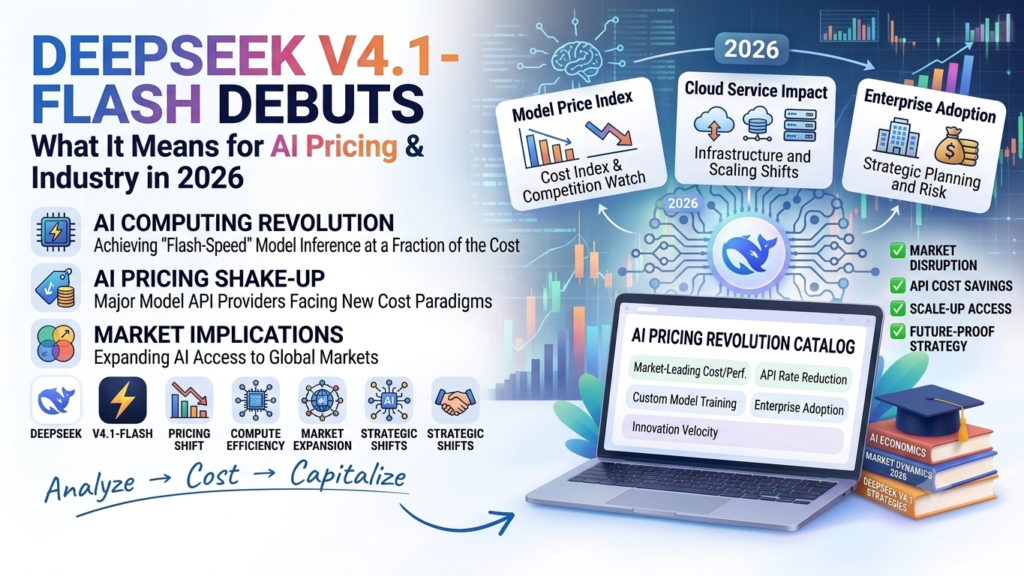
DeepSeek V4.1-Flash : DeepSeek V4.1-Flash’s cheap API rates, quicker inference, and scalable performance are putting new pressure on AI model pricing. Here are the implications of the new approach for developers, startups, companies, and the future of AI pricing.
Another significant pricing war is about to break out in the AI sector. DeepSeek V4.1-Flash, a new model from the Chinese AI startup DeepSeek, is intended to provide faster inference, increased throughput, and enhanced scalability while maintaining incredibly cheap API costs. The model was unveiled on September 10, 2026, and the AI sector is already taking notice of its cost.
DeepSeek V4.1-Flash comes at a time when AI firms are competing not only on intelligence and benchmark performance but also on cost per token, inference efficiency, and the cost-effectiveness of managing AI agents on a large scale. According to DeepSeek’s current price, off-peak rates are $0.15 per million input tokens and $0.60 per million output tokens, while peak rates are $0.30 and $1.20, respectively.
DeepSeek’s most recent Flash model, DeepSeek V4.1-Flash, is focused on high-volume AI workloads, efficiency, and speed. DeepSeek is stressing the capacity to provide practical AI capabilities at a lower inference cost rather than concentrating only on largest model size or premium pricing.
According to Reuters, DeepSeek characterizes V4.1-Flash as the smallest component of its new model architecture, with enhancements targeted at scalability, throughput, and inference speed.
The timing is crucial. Applications centered around chatbots, coding assistants, AI agents, automated research, and other workloads that can produce massive volumes of model calls are becoming more and more popular among AI engineers.
The most obvious impact of V4.1-Flash is its pricing.
$0.15 per million uncached input tokens and $0.60 per million output tokens at off-peak times are listed in DeepSeek’s current price description. These rates rise to $0.30 per million input tokens and $1.20 per million output tokens during peak times.
Peak and off-peak pricing are also used by DeepSeek. On weekdays, its recorded peak windows are 01:00–04:00 UTC and 06:00–10:00 UTC; lesser rates apply during other times.
This is significant because makers of AI products may be able to lower their infrastructure costs by scheduling flexible workloads for less expensive times.
The larger point—that AI intelligence is becoming more and more commercialized—is considerably more crucial.
As more providers release capable models at lower prices, companies offering premium AI APIs have to justify their pricing through superior reasoning, reliability, speed, ecosystem integration, specialized capabilities or enterprise services.
DeepSeek’s pricing strategy comes after an unusual period for the company.
In August 2026, DeepSeek implemented peak and off-peak pricing and raised API prices for its V4 models. According to Reuters, depending on the model, token type, and usage duration, the changes reflected rises ranging from 50% to 1,100%.
Additionally, DeepSeek V4 Pro was marketed as being substantially more costly than V4 Flash due to its sophisticated features.
Thus, the release of V4.1-Flash demonstrates that the company’s approach goes beyond just “making things cheaper.”
Instead, DeepSeek appears to be experimenting with a broader model economics strategy:
This is similar to how cloud computing evolved. Customers eventually stopped buying infrastructure based only on raw hardware specifications and started optimizing around workload, utilization and cost.
AI APIs are moving in the same direction.
One of the biggest reasons AI pricing has become important is the rise of AI agents.
A traditional chatbot might require one or two model calls to answer a question.
An AI agent can be very different.
An agent may:
Each step can require additional model inference.
That means a small difference in the price of individual API calls can become a significant difference when millions of calls are generated.
For example, a startup running an AI coding agent may process thousands or millions of tokens per day. If the model costs substantially less while delivering sufficient performance, the company can either reduce operating expenses or offer more AI usage to customers at the same subscription price.
This makes cost per successful task increasingly important.
Lower AI inference costs can have a major impact on startups.
Previously, a startup might have had to carefully limit AI usage because every additional user generated additional API expenses.
Imagine an AI career platform that uses AI for:
If every interaction requires expensive model calls, the company’s margins can quickly disappear.
But if capable models become significantly cheaper, startups can offer more AI functionality without increasing prices dramatically.
This could result in more experimentation.
Instead of asking:
“Can we afford to add this AI feature?”
Developers may increasingly ask:
“What can we build if intelligence becomes extremely cheap?”
That is potentially a much bigger transformation than simply lowering API prices.
Another important consequence of DeepSeek V4.1-Flash is that developers may become less dependent on a single AI provider.
Instead of using one model for everything, applications can increasingly use a model routing strategy.
For example:
Use a low-cost, high-speed model.
Use a model optimized for software engineering.
Use a premium reasoning model.
Use the cheapest model that provides sufficient accuracy.
Use an on-premise or self-hosted open-weight model.
This creates a new layer of AI infrastructure.
Companies may build systems that automatically select the best model based on:
DeepSeek’s low pricing makes this model-routing approach even more attractive.
Price is only one part of DeepSeek’s strategy.
Another major factor is the growing importance of open-weight AI models.
Recent reporting has highlighted how Chinese AI companies are increasingly producing models that can compete with leading systems while being available at significantly lower costs.
Open-weight models can provide developers with more flexibility.
Instead of relying entirely on an external API, organizations can potentially:
This does not mean every company will immediately self-host AI models. Running large models still requires significant computing infrastructure and engineering expertise.
However, the availability of capable open-weight models gives businesses more negotiating power and more technical options.
The AI market initially revolved heavily around model intelligence.
Every new generation was expected to be:
bigger → smarter → more capable
But the market is becoming more complicated.
Businesses care about the complete economics of an AI system.
A model that is slightly better but several times more expensive may not always be the best choice for a production application.
For many workloads, a cheaper model that is:
may generate more business value.
This is why DeepSeek V4.1-Flash could put pressure on competitors even if it does not dominate every benchmark.
It changes the question from “Who has the smartest model?” to “Who provides the best intelligence-per-dollar?”
Ultimately, increased competition is good news for developers and businesses.
When model providers compete aggressively on price and performance, users receive more choices.
Developers can experiment with more AI features.
Startups can build products with lower infrastructure costs.
Enterprises can process more data.
Students and individual developers can experiment with advanced models without requiring enormous budgets.
And AI applications can become economically viable in areas where expensive inference previously made them difficult to operate.
This is particularly important for AI agents.
As agents become more autonomous, the number of model calls per task could increase dramatically. Lower inference costs could therefore accelerate the transition from simple AI chatbots toward more complex agentic applications.
DeepSeek V4.1-Flash is a new AI model from DeepSeek launched in September 2026. It focuses on fast inference, high throughput, scalability and cost-efficient AI workloads.
DeepSeek’s current API pricing lists off-peak rates of $0.15 per million uncached input tokens and $0.60 per million output tokens. Peak pricing is $0.30 per million input tokens and $1.20 per million output tokens.
Lower AI inference costs make it easier for startups and developers to build AI applications, especially applications involving high-volume processing and AI agents that require many model calls.