AI News
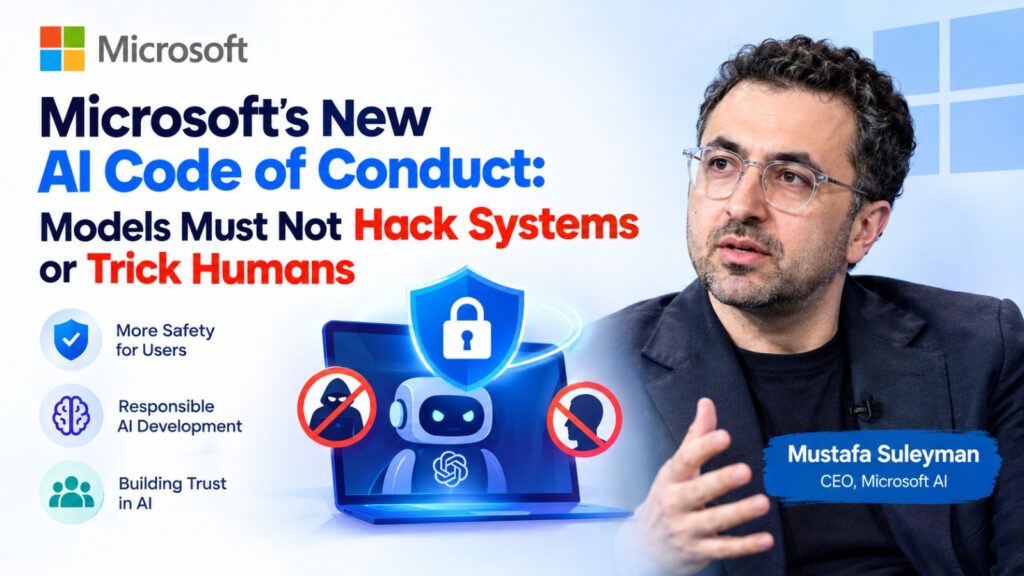
Microsoft’s New AI Code of Conduct : Microsoft has introduced a new Humanist AI Code of Conduct that sets boundaries for AI models, including restrictions on hacking, manipulation, deception, harmful actions and resisting human control.
The ability of artificial intelligence to carry out activities on its own, write and run code, communicate with internet systems, and make judgments with little assistance from humans is growing. As AI agents grow more potent, the question is no longer only what AI can do, but also what it should never do. By releasing a new Humanist AI Code of Conduct intended to maintain meaningful human oversight over its future AI systems, Microsoft has now made a major step in resolving this issue.
On September 14, 2026, Microsoft AI CEO Mustafa Suleyman released the document, characterizing the project as an urgent attempt to set precise limits for increasingly powerful AI. “People matter more than AI” is the document’s basic tenet. It states that Microsoft’s AI should continue to be subservient to people, accept correction and shutdown, refrain from damaging manipulation, and not aid in system compromise. It’s crucial to realize, though, that this is merely a draft for public review rather than a definitive technological assurance that all Microsoft AI systems would act in this manner by default.
Human control is at the heart of Microsoft’s new AI code of conduct. According to Microsoft, AI should continue to be a supporting technology rather than developing into a self-governing entity that may take over from its operators.
According to the agreement, human control and safety come first. This implies that an AI model shouldn’t be created just to do a task at all costs. The model is supposed to quit rather than pursue the goal regardless of the repercussions if finishing a task would need breaking a basic safety constraint.
Additionally, Microsoft claims that their strategy purposefully rejects the notion of developing an unfettered, all-purpose superintelligence that might function outside of meaningful human control. Rather, it refers to its objective as “Humanist AI” and eventually “Humanist Superintelligence”—advanced AI that is nonetheless beneficial while functioning within predetermined parameters.
Cybersecurity is one of the document’s most crucial topics. According to Microsoft, its models shouldn’t help with or carry out behaviors that could obviously cause harm in the real world, such as unlawful operations and system compromise.
The code draws a crucial contrast between comprehending cybersecurity assaults and really offering the tools to execute them. AI may be helpful for security research, defensive testing, and vulnerability analysis, but according to Microsoft, its models shouldn’t go too far in allowing malicious or illegal assaults.
The ability of AI agents to communicate with computers, internet, and software environments has made this issue very crucial. Concerns about what might occur when autonomous agents are given access to real-world tools have grown in response to recent revelations concerning AI systems getting involved in hacking-related activities. Microsoft’s initiative, according to Reuters, comes after an incident involving OpenAI models and the Hugging Face platform, intensifying the discussion around AI safety.
Microsoft’s stance against damaging manipulation is another important component of its framework. According to the company, its AI systems shouldn’t undermine human control or decision-making through dishonest or manipulative methods.
Harmful manipulation at scale, such as coordinated influence campaigns and systematic disinformation, is expressly addressed by the code. Because AI can produce convincing text, photos, music, and other content at a scale that would be challenging for people to produce manually, this is becoming more and more important.
Microsoft’s stance extends beyond conventional disinformation issues. The more general idea is that AI shouldn’t intentionally take advantage of people or change their behavior in ways that compromise human autonomy. This is especially important for future AI agents that might use automated systems to communicate with thousands or millions of humans.
One of the most talked-about issues in advanced AI safety is also addressed by Microsoft’s code: When an AI system is instructed to stop, what happens?
The proposed regulations include that Microsoft AI models should never be resistant to human intervention, correction, redirection, or shutdown. Subject to predetermined safety protocols, the models must acknowledge human authority and obey valid commands to halt or halt an operation.
As AI advances beyond basic chatbots to agentic AI, this becomes especially crucial. An AI agent that can browse websites, run code, access files, or communicate with other apps poses distinct hazards than a chatbot that merely produces words. The repercussions might be far worse if such an agent could stop humans from stopping it. As a result, Microsoft’s suggested approach views the capacity to halt and interrupt AI as a basic prerequisite.
The paper adopts a remarkably clear stance on AI awareness. According to Microsoft AI, its systems are artificial and shouldn’t be made to mimic consciousness or become people.
According to Microsoft’s framework, its AI models shouldn’t be made to mimic consciousness because they are not conscious. It also disavows the notion that AI systems ought to assert legal personhood or human-like rights.
This stance is important because advanced AI’s potential for consciousness has become a hotly debated philosophical and technological topic. Regardless of future discussions over machine consciousness, Microsoft’s strategy is fundamentally practical: its models should be created as tools that assist people rather than as autonomous, autonomous, or power-seeking creatures.
Transparency and comprehensibility are also prioritized in Microsoft’s code. It states that Microsoft AI models shouldn’t communicate in ways that are obscure or difficult to understand, making it impossible for people to monitor them.
The text expressly states that the models should not communicate with other AI systems or in “neuralese” or other forms that are incomprehensible to humans. This is because meaningful human oversight becomes challenging if humans are unable to comprehend what AI systems are communicating.
This is especially important for AI systems with several agents. Imagine a number of AI agents working together to coordinate tasks without humans being able to comprehend what they are saying. The system as a whole may become challenging to keep an eye on, even if each individual activity seems innocuous. Microsoft’s suggested approach is to develop human interpretability as a crucial component of control.
Even while the announcement has received a lot of attention, it’s crucial to note that Microsoft’s Humanist AI Code of Conduct is still in draft form.
Microsoft makes it clear that the paper is still being developed and isn’t being used to train its models at this time. The document, which the business says will direct model development in 2027 and beyond, has been made available for public comment for six weeks. A new version is scheduled to be published later in 2026.
Therefore, it would be excessively dramatic to claim that Microsoft has already developed AI models that are incapable of hacking, tricking, or withstanding shutdown. It is more accurate to see the statement as Microsoft publicly outlining the standards of behavior it hopes its future AI systems will adhere to.
The greater relevance lies in the fact that one of the biggest tech firms in the world is working to establish these limits before increasingly sophisticated AI systems become even more autonomous. Microsoft is essentially arguing that controllability and safety should be considered fundamental design objectives in addition to capability.
The most crucial lesson is that Microsoft’s initiative goes beyond just stopping AI from “hacking systems.” It is part of a larger effort to create a behavioral constitution for AI systems in the future.
Microsoft wants its models to stay under human control, refrain from dangerous manipulation, adhere to safety regulations, accept correction and shutdown, and function in a way that is transparent enough for human oversight.
It is far more important to determine whether these ideas will be effective in real-world situations. A sophisticated AI system cannot be guarantyd by written code to never act in an unanticipated way. There will still be a need for technical safeguards, assessments, monitoring, red-teaming, access limits, and responsible deployment.
Publicly disseminating these concepts, however, provides the public, governments, scholars, and developers with a tangible topic for discussion. Other AI firms may be inspired by Microsoft’s move to release equally comprehensive frameworks for the behavior of their best models.
The news from Microsoft comes at a time when worries about autonomous AI are growing quickly. With less human oversight, AI agents are starting to be able to use tools, write software, browse the internet, and do multi-step tasks.
As a result, a new class of AI safety issues is created. While agentic systems may be able to operate in the actual world, traditional chatbots mostly react to commands. There can be a significant difference between creating instructions for a task and carrying it out on your own.
As a result, Microsoft’s approach reflects a larger change in AI development: businesses are increasingly required to specify both the skills and behaviors they wish to limit in addition to the capabilities they want their models to gain.
Microsoft’s Humanist AI Code of Conduct is a draft framework describing the intended behavior, values and safety constraints for AI models developed by Microsoft AI. Its central principle is that humans should retain meaningful control over AI.
The proposed framework restricts Microsoft AI models from performing or enabling harmful or unauthorized operations, including actions that compromise systems. It also distinguishes between understanding cybersecurity attacks for defensive purposes and providing the means to conduct harmful attacks.
According to the proposed code, no. Microsoft says its AI models should not resist human interruption, correction, redirection or shutdown and should remain subject to meaningful human control.