TypeSafe Introduces Jev, an AI Model for Structured Software Decisions
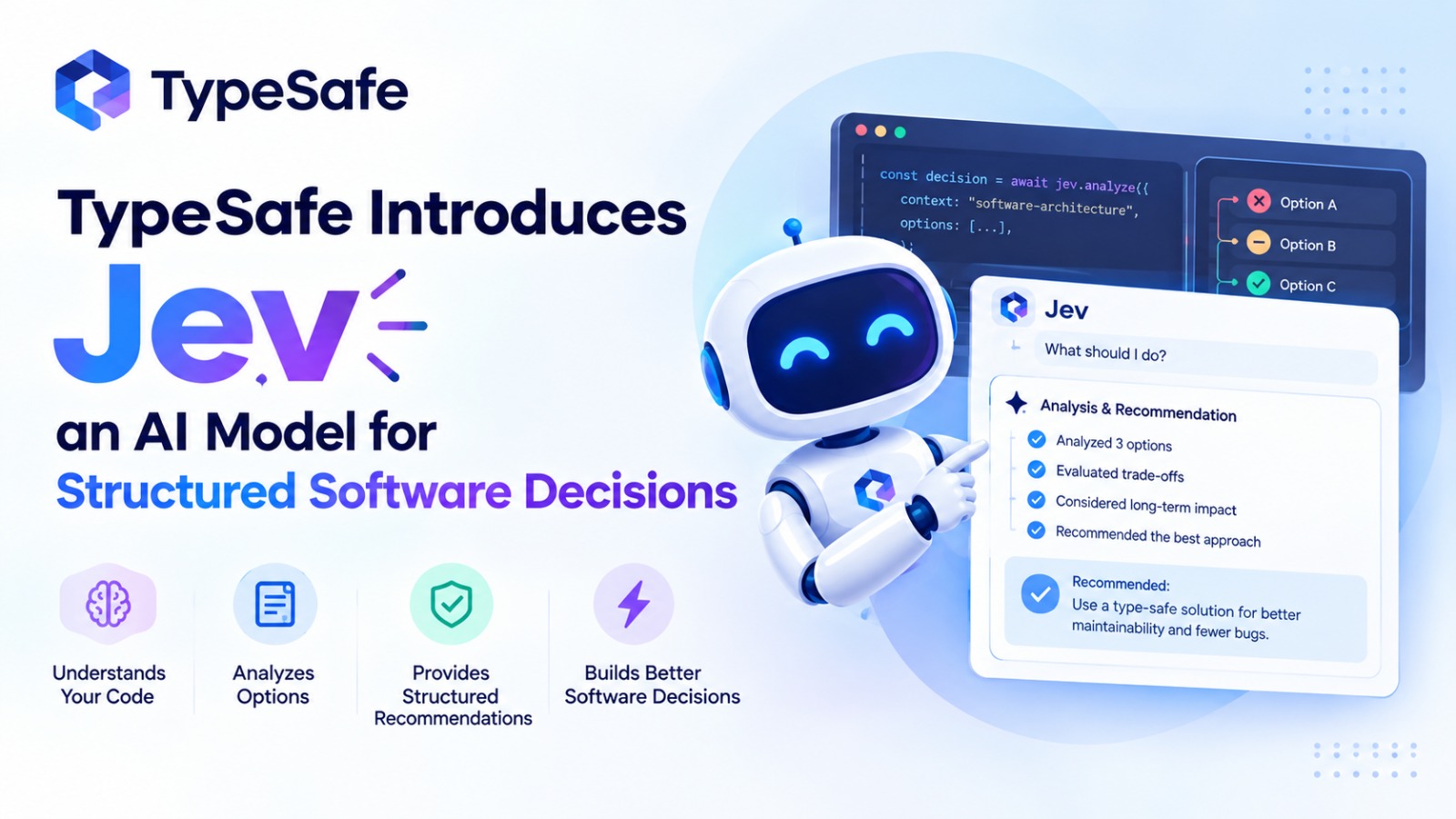
Most artificial intelligence models are designed to communicate with humans. ChatGPT, Gemini, Claude and other large language models generate text, answer questions, write code and perform complex reasoning. But software applications often need something much simpler: a fast decision. Should this customer request go to sales or support? Should an AI agent retry a failed task? Is this transaction suspicious? Should a piece of content be approved or sent for human review? TypeSafe AI is targeting this layer of software intelligence with Jev, a new AI model launched on September 15, 2026.
Jev is different from a conventional chatbot because it is not designed primarily to write responses. TypeSafe describes it as a “System One Model” that takes unstructured state and produces typed, probabilistic decisions that software can use directly. The company says Jev is designed to be fast, inexpensive and reliable for high-volume decisions, making it particularly relevant to AI agents and automated business workflows.
1. What Is Jev?
Jev is an AI decision-making model developed by TypeSafe AI. Instead of asking the model to generate a paragraph explaining what should happen next, developers can define the possible decisions and ask Jev to select between them.
For example, an application could give Jev a customer support request and ask whether it belongs to Sales, Technical Support, Billing or Other. Jev returns a structured decision and associated probabilities rather than a natural-language explanation. TypeSafe describes this basic concept as “decisions, not strings.”
This makes Jev fundamentally different from the way most generative AI applications are built. With a traditional LLM, software may need to interpret generated text and then convert that text into an action. Jev is designed to provide the structured decision directly, allowing software to use the result in its existing logic.
2. Jev Is Designed for Software, Not Chat
Traditional LLMs are primarily optimized for interactions involving humans. They generate language because humans need language to communicate.
But software does not necessarily need a paragraph. It often needs a value such as true or false, category A or B, score 1–5, continue or stop, retry or escalate.
TypeSafe's argument is that using a large generative model for every small software decision can be inefficient. Jev is designed specifically for these bounded decisions. Its outputs can include a Choice, a Score, or a probability-based yes/no decision called a Noul, according to TypeSafe's product information.
This approach could allow developers to put AI directly into ordinary software logic. Instead of creating a chatbot interface, developers can use AI as a decision-making component inside an existing application.
3. Jev Could Become a Decision Layer for AI Agents
One of the most interesting applications for Jev is AI agents.
An autonomous AI agent often has to make many small decisions while completing a task. It may need to determine which tool to use, whether to continue working, whether a result is good enough, whether it should retry an operation or whether a human should take over.
These decisions do not always require a long response from a frontier language model. Jev is designed to act as a fast decision layer within these workflows. Vercel, which made Jev available through its AI Gateway, lists examples such as choosing the next tool or subagent and deciding whether an agent should continue, retry, ask the user or stop.
This creates a potential hybrid architecture: a powerful LLM can handle complex reasoning and content generation, while Jev handles the frequent structured decisions surrounding that work.
4. Jev Returns Probabilities and Confidence
Another important feature is that Jev is designed to return probabilistic decisions.
Instead of simply saying that a customer request belongs to the “Sales” category, a decision model can provide a probability associated with the decision. This gives software an additional way to determine whether it should automatically act or ask a human to review the case.
For example, a company could create a simple threshold:
Confidence above 90% → automate
Confidence below 90% → human review
TypeSafe's product website specifically describes this approach, saying developers can set thresholds for autonomous action and escalation.
This is potentially useful for business automation because not every AI decision needs the same level of human involvement. High-confidence cases could move automatically through a workflow, while uncertain cases could be routed to employees.
5. TypeSafe Says Jev Is Extremely Fast and Cheap
Cost and latency are central to TypeSafe's pitch.
According to TypeSafe, Jev can respond in roughly 70 to 500 milliseconds, depending on the workload. The company currently lists a price of $0.042 per million input tokens, with output unmetered.
The company has also published workflow evaluations claiming that Jev was up to 193.6 times faster and 444.6 times cheaper than the LLM baselines it tested. These are TypeSafe's own evaluation results, so they should be understood as vendor-reported benchmarks rather than independent verification.
If the economics hold across large production workloads, the implications could be significant. A business processing millions of small decisions may not need to send every request through a large, expensive generative model.
6. Jev Could Be Used for Business Automation
The technology is particularly relevant to businesses because many business processes contain repetitive decisions.
Consider customer support. A company could use an LLM to understand a complicated customer message, while Jev determines the appropriate workflow:
Billing → Finance team
Technical issue → Technical support
Sales inquiry → Sales team
High uncertainty → Human review
Another example is lead qualification. A company's software could provide Jev with information about a lead and ask it to assign a predefined qualification score. The application could then automatically determine whether the lead should be prioritized, placed into a nurturing workflow or sent to a sales representative.
TypeSafe's own product positioning highlights routing, classification, scoring and gating as key applications for Jev.
7. Jev Does Not Replace ChatGPT-Style AI Models
One important point is that Jev is not intended to replace general-purpose LLMs.
A model such as ChatGPT is useful when a user asks an open-ended question, requests an explanation, wants code written or needs a long-form document generated. Those tasks require language generation and broader reasoning capabilities.
Jev is designed for a narrower category of problems where the possible output can be defined in advance. TypeSafe itself describes Jev as complementary to traditional language models rather than a replacement for them.
A future AI application could therefore use both technologies. A large language model could perform research and reasoning, while Jev handles fast routing, scoring and control decisions around the workflow.
8. TypeSafe Calls This a New “System One” Model
TypeSafe uses the term System One Model to describe Jev's architecture.
The name is inspired by Daniel Kahneman's distinction between fast, intuitive “System 1” thinking and slower, deliberate “System 2” thinking. TypeSafe's idea is to create AI intelligence optimized for the many small decisions that software needs to make quickly.
TypeSafe says its approach uses a training method called Reinforcement Learning for Calibrated Decisions (RLCD). The company also says Jev uses a new architecture and parallel sampling approach designed around structured decisions rather than sequential text generation.
The significance of this approach is architectural. Instead of treating AI as a chatbot that is occasionally connected to software, TypeSafe is trying to make intelligence itself a component that software can call like a function.
Why Jev Could Matter for AI Agents
AI agents are becoming more complex. A single agent may need to make dozens or hundreds of decisions during a workflow.
If every decision requires a large language model to generate text, the system can become expensive and slow. Developers also need to parse the generated output and make sure it conforms to the expected structure.
A dedicated decision model could potentially simplify this process.
The architecture could look something like:
User request → LLM reasoning → Jev decision → Software action → Result → Jev decision → Next action
In this setup, the LLM handles complex reasoning while Jev handles smaller, repeated decisions.
This could make AI-agent systems more efficient, especially in workflows that operate at high volume.
Jev and the Future of Software
- The larger idea behind Jev is that AI does not always need to appear as a chatbot.
- AI could become an invisible component inside everyday software.
- A CRM system could use AI to score leads.
- A cybersecurity platform could use AI to prioritize alerts.
- A customer-service platform could route tickets automatically.
- An AI coding agent could use a decision model to determine whether it should retry a task or request human assistance.
- An e-commerce platform could classify customer requests and determine the appropriate workflow.
- In all of these cases, users may never directly interact with the AI model. The intelligence simply operates behind the interface.
- That is arguably the most interesting part of TypeSafe's approach: AI could become part of software infrastructure rather than something users open in a separate chat window.
Who Is Behind TypeSafe AI?
TypeSafe AI was founded by Diogo Almeida, a former OpenAI researcher who worked on instruction-following research that contributed to the technology behind ChatGPT. TypeSafe spent roughly two years in stealth before publicly launching Jev in September 2026.
The company launched Jev alongside a $40 million seed round led by DCVC, according to reporting about the company's launch.
Jev is currently available in early access, with TypeSafe inviting developers to test the model and provide feedback about where it works and where it falls short.
More for your curious side.
Google Gemini 4 Carbon: New AI Model Leads Across Coding, Cybersecurity and Long-Context Benchmarks
Google Gemini 4 Carbon: New AI Model Leads Across Coding, Cybersecurity and Long-Context Benchmarks Google Gemini 4 Carbon is making headlines in the…

Microsoft’s Biggest Exit Offer Ever: 60,000 Employees, Including India
Microsoft has introduced a Voluntary Exit Offer (VEO) that could cover approximately 60,000 employees across the United States, India, the United Kingdom and…

Freshers Read This: IIT Madras Study Says AI Could Shrink Your First Job Options
Every year, lakhs of students in India finish college with one hope: a first job that lets them learn, grow and move up.…