Google Gemini 4 Carbon: New AI Model Leads Across Coding, Cybersecurity and Long-Context Benchmarks
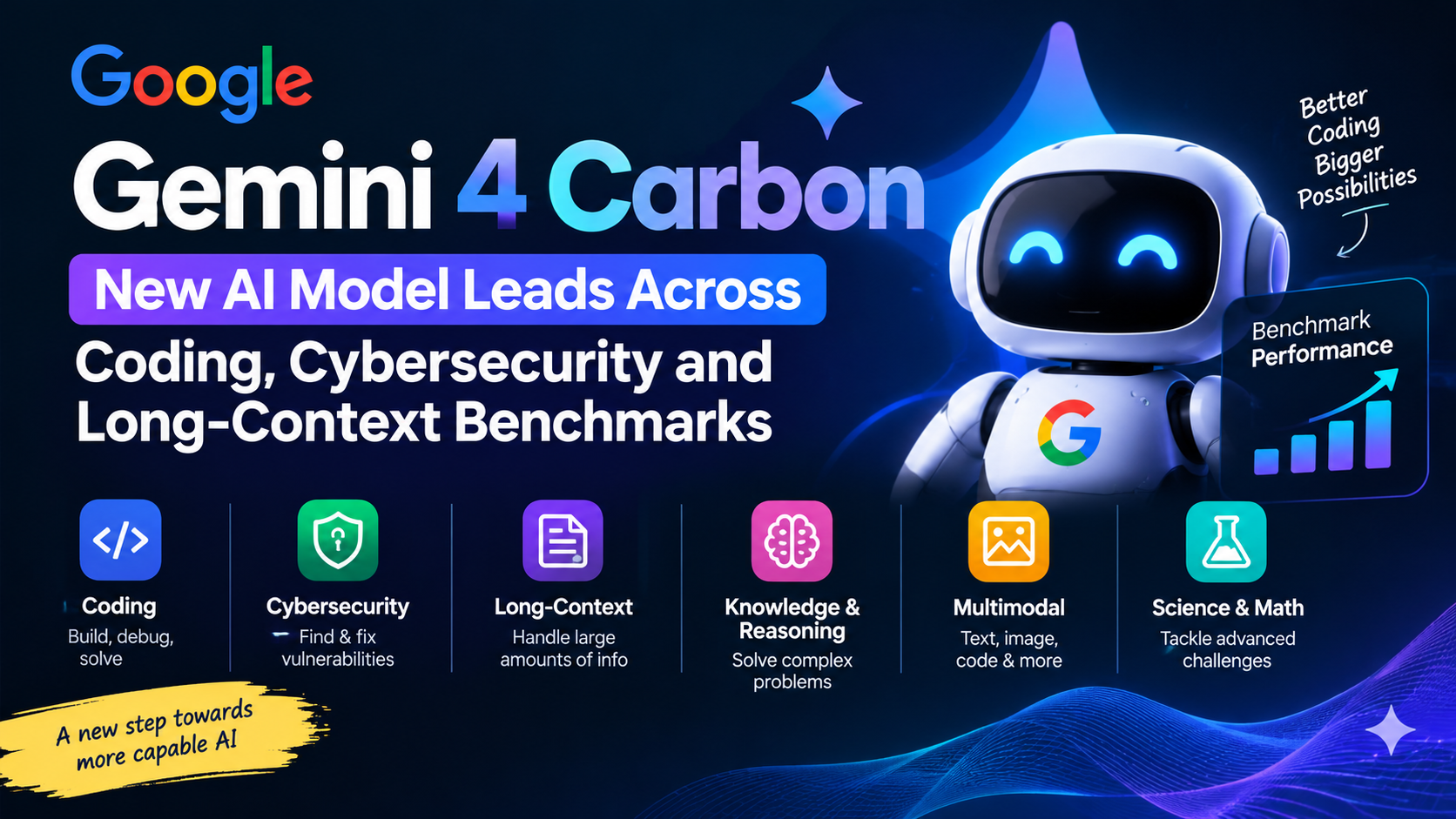
Google Gemini 4 Carbon: New AI Model Leads Across Coding, Cybersecurity and Long-Context Benchmarks
Google Gemini 4 Carbon is making headlines in the AI industry with impressive benchmark results across coding, computer use, knowledge work, multimodal understanding, science and cybersecurity. Announced on October 28, 2026, Gemini 4 Carbon builds on Gemini 4 Argon and is designed to handle complex, long-running engineering tasks.
According to Google's published evaluation results, Gemini 4 Carbon achieves strong scores across several benchmarks, outperforming competing models in many of the tested categories. However, other models still lead on certain tasks, showing that no single AI model is the best at everything.
For AI engineers, developers, students and freshers, this release offers an important lesson: the future of AI is not just about generating answers. It is about solving complex problems, writing better code and completing real-world tasks.
What is Google Gemini 4 Carbon?
Gemini 4 Carbon is Google's latest frontier AI model, developed to improve performance on demanding engineering, coding, scientific and cybersecurity tasks.
Unlike workflows focused only on answering questions, Carbon is designed to work through complicated, multi-step problems, investigate bugs, make code changes and continue working through challenging tasks.
Google has highlighted several areas of improvement, including:
- AI coding: Handling complex software engineering tasks and debugging.
- AI agents: Executing multi-step workflows with greater reliability.
- Cybersecurity: Finding software vulnerabilities, validating exploits and helping fix security issues.
- Long-context reasoning: Working with large amounts of information across extended tasks.
- Science and mathematics: Tackling demanding analytical and scientific problems.
- Computer use: Interacting with software environments to complete tasks.
Google is initially rolling out the model to selected cyber defenders before expanding access to additional trusted partners.
Gemini 4 Carbon vs Gemini 4 Argon vs GPT-6 Astra vs Claude
Google's published comparison covers 17 benchmarks across several AI capability areas.
Here are some notable results from the comparison:
| Benchmark | Gemini 4 Carbon | Gemini 4 Argon | GPT-6 Astra | Claude Opus 5.5 |
|---|---|---|---|---|
| AA Index v5.0 | 59 | 50 | 57 | 58 |
| Terminal-Bench 4.0 | 65.2% | 57.1% | 59.1% | 59.6% |
| Agents' Last Exam v1.1 | 77.4% | 69.0% | 73.1% | 71.6% |
| AutomationBench | 53.9% | 51.3% | 41.4% | 42.5% |
| GraphWalks (long context) | 96.2% | 84.2% | 71.8% | 66.8% |
| RiemannBench | 80.0% | 76.0% | 72.0% | 69.6% |
| CWE-bench (cybersecurity) | 71.0% | 68.0% | 68.0% | 67.0% |
| ExploitGym | 54.8% | 42.0% | 42.4% | 34.5% |
| SEC-bench Pro | 88.2% | 83.4% | 85.4% | Not reported |
Source: Google's published Gemini 4 Carbon benchmark comparison. Missing scores are not treated as zero. Results are specific to each benchmark and evaluation setup.
The results show substantial progress across multiple areas. However, the comparison also demonstrates why benchmark results must be interpreted carefully.
For example, GPT-6 Astra scores higher on FrontierSWE 2, while Claude Opus 5.5 leads on the OSWorld-2.1 computer-use benchmark. These differences highlight how model performance depends on the task being evaluated.
Why Gemini 4 Carbon matters for AI engineers
The biggest takeaway is the growing importance of AI systems that can do more than generate code snippets.
Consider a typical software engineering task. A developer may need to understand an unfamiliar codebase, identify the root cause of a bug, implement a fix, write tests and verify that the change works without breaking existing functionality.
This requires reasoning, code understanding, debugging and validation.
As AI models improve at handling these workflows, developers need to become better at evaluating AI-generated code, designing reliable systems and understanding the software they build.
Here are three important areas to focus on:
1. AI-assisted software engineering
Learn how to use AI coding assistants to understand existing code, debug errors, generate tests, refactor applications and review code.
Do not stop at generating a working demo. Learn how to build software that is maintainable, secure and reliable.
2. AI agents and automation
AI agents are becoming increasingly important because they can combine language models with tools, APIs, memory and multi-step workflows.
Start building practical projects such as customer support agents, recruitment automation systems, research assistants or business workflow automation tools.
Understand tool calling, structured outputs, evaluation, error handling and human approval where necessary.
3. AI security and responsible development
As AI models become more capable of finding vulnerabilities and interacting with software, security becomes increasingly important.
Learn secure coding practices, authentication, authorization, API security, dependency management and how to test AI-powered applications safely.
The goal is not simply to use AI faster. It is to build systems that people can trust.
What should students and freshers learn in the AI era?
For students preparing for AI and software engineering jobs, constantly switching between new AI tools is not a long-term strategy.
Instead, build a strong foundation and apply it through practical projects.
A useful learning roadmap includes:
- Programming fundamentals: Python, data structures, APIs and debugging.
- Machine learning: Data preparation, model training, evaluation and deployment.
- Generative AI: LLMs, embeddings, retrieval-augmented generation (RAG) and prompt design.
- AI agents: Tool calling, workflow orchestration and reliable task execution.
- Deployment: Git, databases, cloud platforms, monitoring and production debugging.
- Portfolio projects: Build applications that solve real problems and document your technical decisions.
You do not need to master every new model released by every AI company. You need to understand the fundamentals well enough to adapt when the tools change.
Will advanced AI models replace software engineers?
The release of more capable AI models naturally raises questions about the future of software engineering jobs.
A more useful way to look at the situation is to understand how the work itself is changing.
AI can help automate parts of coding, testing, research and debugging. At the same time, building production-ready software still involves understanding requirements, making architectural decisions, validating outputs, managing risks and taking responsibility for the final result.
The advantage will increasingly go to engineers who know how to combine technical fundamentals with effective AI-assisted development.
For freshers, this means learning to build real applications instead of relying entirely on tutorials or copying AI-generated code without understanding it.
Final thoughts
Gemini 4 Carbon is another important development in the rapidly evolving AI landscape. Its benchmark results highlight progress in coding, long-context reasoning, agentic workflows and cybersecurity.
But the most important lesson is not which model ranks first today. AI models will continue to improve, and benchmark leaders may change with the next release.
For students and developers, the best investment is learning how to build, evaluate and deploy AI-powered solutions.
At Common Jobs AI University, our focus is to help students and freshers understand emerging AI technologies through practical learning, projects and career-oriented preparation.
The AI industry is moving quickly. Start learning, start building and keep adapting.
Frequently Asked Questions (FAQs)
What is Google Gemini 4 Carbon?
Gemini 4 Carbon is Google's frontier AI model announced on October 28, 2026. It is designed for complex engineering tasks, coding, long-horizon workflows and cybersecurity applications.
Is Gemini 4 Carbon better than GPT-6 Astra?
Gemini 4 Carbon scores higher on several benchmarks in Google's published comparison. However, GPT-6 Astra performs better on certain tasks, including FrontierSWE 2. The best model depends on the workload and evaluation method.
What are the main features of Gemini 4 Carbon?
Its highlighted capabilities include agentic coding, computer use, long-context reasoning, knowledge work, scientific reasoning and cybersecurity tasks.
What should freshers learn to prepare for AI jobs?
Freshers should focus on programming, machine learning fundamentals, generative AI, AI agents, APIs, deployment, security and practical project development.
Will AI replace software engineering jobs?
AI is automating parts of software development, but engineers still need to understand requirements, validate code, design systems and ensure reliability. Learning to work effectively with AI is an important way to prepare for changing job requirements.
SEO title: Google Gemini 4 Carbon: Benchmarks, Features and AI Career Impact
Meta description: Explore Google Gemini 4 Carbon benchmarks, coding performance, AI agents, cybersecurity capabilities and what students and freshers should learn for AI careers.
Suggested URL slug: google-gemini-4-carbon-benchmarks-features
Primary keyword: Google Gemini 4 Carbon
Secondary keywords: Gemini 4 Carbon benchmarks, Google AI model, Gemini 4 Carbon vs GPT-6 Astra, AI coding models, AI agents, AI engineer roadmap, AI careers for freshers
Suggested category: Artificial Intelligence / AI News
Suggested tags: Google Gemini, Gemini 4 Carbon, Artificial Intelligence, AI Engineering, AI Agents, Machine Learning, AI Careers
More for your curious side.

Microsoft’s Biggest Exit Offer Ever: 60,000 Employees, Including India
Microsoft has introduced a Voluntary Exit Offer (VEO) that could cover approximately 60,000 employees across the United States, India, the United Kingdom and…

Freshers Read This: IIT Madras Study Says AI Could Shrink Your First Job Options
Every year, lakhs of students in India finish college with one hope: a first job that lets them learn, grow and move up.…
This $399 Robot Duck Is Teaching Us How AI Learns to Move
Meet Microduck, the 25 cm open-source robot from Hugging Face and Pollen Robotics. Price, specs, how it learns with reinforcement learning, and why…