OpenAI Launches GPT-6.1 Sol: Near-Astra Performance at a Lower Cost
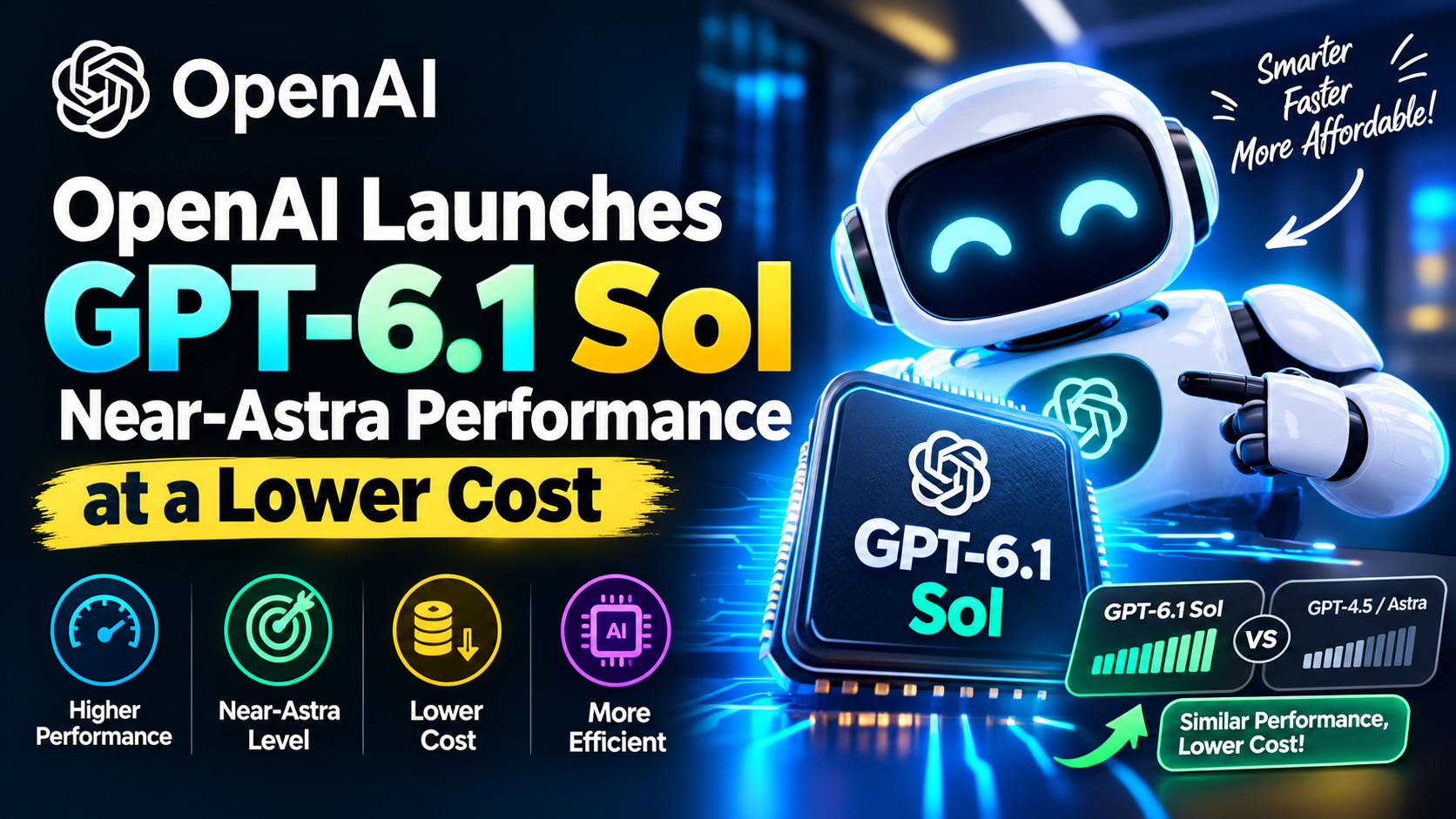
OpenAI has launched GPT-6.1 Sol, the latest addition to its GPT-6 model family, introducing a new model focused on delivering advanced reasoning and agentic capabilities at a significantly lower cost than its flagship GPT-6 Astra. Announced on September 29, 2026, GPT-6.1 Sol is designed for complex coding, computer use, professional workflows and AI agents. OpenAI describes it as delivering performance close to Astra while offering a much more affordable pricing structure.
The timing of the launch is also important. OpenAI had introduced GPT-6 Sol and GPT-6 Luna only a week earlier, making GPT-6.1 Sol a rapid upgrade to the Sol line. The new model keeps the same standard input and output pricing as GPT-6 Sol but reduces cached-input pricing to just $0.10 per million tokens. OpenAI is positioning GPT-6.1 Sol as a model that can handle demanding AI workloads without requiring developers to pay flagship-model prices for every task.
What Is GPT-6.1 Sol?
GPT-6.1 Sol is OpenAI's newest Sol-series reasoning model, designed for complex professional and agentic workloads.
According to OpenAI's developer documentation, GPT-6.1 Sol delivers near-Astra performance for complex coding, computer use and professional work. It supports reasoning efforts ranging from low through maximum, allowing developers to trade off reasoning depth, speed and cost depending on the task.
The model is available through the OpenAI API and is also being rolled out to ChatGPT Work and Codex for eligible paid users. It is currently positioned separately from the models available in regular ChatGPT conversations.
1. GPT-6.1 Sol Is Designed to Bring Astra-Level Capabilities to More Workloads
The biggest message behind GPT-6.1 Sol is price-performance. GPT-6 Astra remains OpenAI's most capable model for the hardest workloads, but GPT-6.1 Sol is intended to bring many of Astra's capabilities into a cheaper model.
OpenAI specifically highlights coding, computer use and professional work. This makes GPT-6.1 Sol particularly relevant for developers and companies building AI agents, because those applications can require thousands or millions of model calls. Lower inference costs can make it more practical to deploy capable agents at scale.
This is different from simply launching a larger or more powerful model. OpenAI is trying to make advanced reasoning economically practical for a much broader set of workloads.
2. GPT-6.1 Sol Comes With a Major Pricing Advantage
Pricing is one of the most important parts of the GPT-6.1 Sol launch.
OpenAI lists standard API pricing at:
- $2 per 1 million input tokens
- $0.10 per 1 million cached input tokens
- $10 per 1 million output tokens
Cache writes are priced at $2.50 per million tokens. OpenAI also states that Fast mode costs twice the standard rate, while Batch and Flex processing are available at lower rates.
The $0.10 cached-input price is particularly important for agentic applications. AI agents frequently reuse large amounts of context across multiple steps. When that context can be cached, developers can reduce the cost of repeated model calls substantially.
3. GPT-6.1 Sol Has a 1 Million Token Context Window
GPT-6.1 Sol supports a 1,050,000-token context window, with up to 128,000 output tokens.
A large context window is valuable for professional AI applications because complex tasks often require more information than a simple chatbot conversation. An AI coding agent may need to work with a large repository, while a research system may need to process extensive documents, reports and supporting information.
The large context window also becomes important for AI agents that maintain context across multiple stages of a workflow. Instead of repeatedly reducing information to small snippets, developers can provide substantially larger amounts of relevant context when appropriate.
4. GPT-6.1 Sol Is Built for AI Agents and Computer Use
One of the most important capabilities of GPT-6.1 Sol is its support for agentic workflows and computer use.
OpenAI's API documentation lists support for tools including web search, file search, code interpreter, hosted shell, computer use, MCP, tool search, image generation and apply-patch capabilities. It also supports function calling and structured outputs.
This means GPT-6.1 Sol is not designed simply as a text-generation model. Developers can build systems where the model reasons about a task, uses external tools, examines information, executes operations and continues working through multiple steps.
That makes the model particularly relevant to the current growth of AI agents. The AI industry is increasingly moving toward systems that can perform tasks rather than simply answer questions.
5. Coding Is One of GPT-6.1 Sol's Major Strengths
Coding is one of the areas where OpenAI is positioning GPT-6.1 Sol as a major improvement over the earlier GPT-6 Sol.
OpenAI's reported evaluations include DeepSWE v1.1, a benchmark focused on software-engineering tasks. Independent analysis of the launch results reported that GPT-6.1 Sol reached a 75.2% score at high reasoning effort in OpenAI's evaluation, compared with GPT-6 Astra's best reported score of 74.1% at a higher cost per task. These are OpenAI-reported benchmark results, so they should be interpreted as vendor evaluations rather than independent verification.
For developers, the significance is not simply the benchmark number. Coding agents need to inspect code, understand dependencies, generate patches, run tests and iterate. A model that can perform these tasks at lower inference cost can make autonomous or semi-autonomous software development more economically attractive.
6. GPT-6.1 Sol Targets Professional AI Work
OpenAI is also targeting GPT-6.1 Sol at broader professional workloads beyond programming.
The model is designed for tasks involving complex reasoning, document understanding, computer use and multi-step workflows. OpenAI's model documentation describes it as a model for complex coding, computer use and professional work.
This means potential applications can extend to areas such as research, business analysis, data processing, operations, document workflows and automation. Instead of using a highly expensive flagship model for every operation, organizations can potentially use GPT-6.1 Sol for large portions of their AI workloads and reserve more expensive models for tasks that genuinely require them.
7. GPT-6.1 Sol Is Available in the API, Work and Codex
Developers can access GPT-6.1 Sol through the OpenAI API using the model identifier gpt-6.1-sol. OpenAI's API documentation also lists support for both US and EU data residency.
The model is also being rolled out in ChatGPT Work and Codex. OpenAI's documentation says GPT-6.1 Sol, GPT-6 Sol and GPT-6 Luna are models for Work and Codex and are separate from the models available in regular ChatGPT conversations. Availability depends on the user's plan, workspace settings and rollout status.
This positioning shows that GPT-6.1 Sol is aimed heavily at developers, professional users and organizations building or running AI-powered workflows.
8. GPT-6.1 Sol Has Strong Safety Evaluations Too
The launch also comes with a new safety evaluation addendum from OpenAI.
Under OpenAI's Preparedness Framework, GPT-6.1 Sol is classified as Critical for cybersecurity capability and High for biological and chemical capability. OpenAI says GPT-6.1 Sol uses the same safeguards stack as GPT-6 Astra.
OpenAI's published evaluations show that GPT-6.1 Sol is substantially more capable than earlier Sol models in several cybersecurity evaluations, while remaining below GPT-6 Astra on some measures. For example, OpenAI reports a 78.8% pass@1 score on SEC-Bench Pro for GPT-6.1 Sol versus 85.4% for Astra. On ExploitGym, OpenAI reports 35.1% intended-vulnerability success per attempt for Sol versus 42.4% for Astra.
These results highlight an important point: making a model cheaper does not mean removing advanced capabilities. It also means safety systems and evaluations need to keep pace with those capabilities.
GPT-6.1 Sol vs GPT-6 Astra
| Feature | GPT-6.1 Sol | GPT-6 Astra |
|---|---|---|
| Positioning | Near-Astra performance at lower cost | OpenAI's most capable model |
| Input price | $2 / 1M tokens | $10 / 1M tokens |
| Cached input | $0.10 / 1M tokens | $1 / 1M tokens |
| Output | $10 / 1M tokens | $50 / 1M tokens |
| Context window | 1.05M tokens | 1.05M tokens |
| Max output | 128K tokens | 128K tokens |
| Coding | Strong | Highest capability |
| Computer use | Supported | Supported |
| AI agents | Strong fit | Strongest model for demanding work |
| API | Yes | Yes |
The pricing figures come from OpenAI's current model documentation.
Why GPT-6.1 Sol Matters for AI Developers
The most important impact of GPT-6.1 Sol may be its economics.
AI agents can make many model calls while completing a task. An agent that researches a topic, searches the web, reads documents, writes code, executes tests and reviews its own work could consume considerably more tokens than a simple chatbot interaction.
If a capable model can perform these tasks at a substantially lower cost, developers can experiment with more complex agents and organizations can deploy them across more workflows. This could accelerate the shift from basic AI assistants toward AI systems that perform complete digital tasks.
What Does GPT-6.1 Sol Mean for the AI Industry?
GPT-6.1 Sol shows that the AI race is increasingly about more than raw intelligence. Cost, speed, tool use and reliability are becoming equally important.
A model that is slightly less capable than a flagship system but dramatically cheaper can be more useful for many commercial applications. Companies often need to process enormous numbers of requests, and the most expensive model is not necessarily appropriate for every task.
This creates a new model strategy: use frontier models for the hardest problems while deploying highly capable, lower-cost models for the majority of production workloads.
GPT-6.1 Sol and the Future of AI Agents
The introduction is especially significant because it coincides with OpenAI's and other businesses' growing emphasis on autonomous and semi-autonomous AI agents.
Through the API, OpenAI's GPT-6.1 Sol facilitates computer use, hosted shell, web search, file search, MCP, and many tools. Instead than only creating text, these features enable developers to create agents that can communicate with other systems.
Because of this, GPT-6.1 Sol may be a useful model for developing coding agents, research agents, business automation systems, and other applications where AI must use tools, reason, and carry out several tasks.
More for your curious side.
Google Gemini 4 Carbon: New AI Model Leads Across Coding, Cybersecurity and Long-Context Benchmarks
Google Gemini 4 Carbon: New AI Model Leads Across Coding, Cybersecurity and Long-Context Benchmarks Google Gemini 4 Carbon is making headlines in the…

Microsoft’s Biggest Exit Offer Ever: 60,000 Employees, Including India
Microsoft has introduced a Voluntary Exit Offer (VEO) that could cover approximately 60,000 employees across the United States, India, the United Kingdom and…

Freshers Read This: IIT Madras Study Says AI Could Shrink Your First Job Options
Every year, lakhs of students in India finish college with one hope: a first job that lets them learn, grow and move up.…