OKF vs RAG: Is Google’s Open Knowledge Format Replacing RAG?
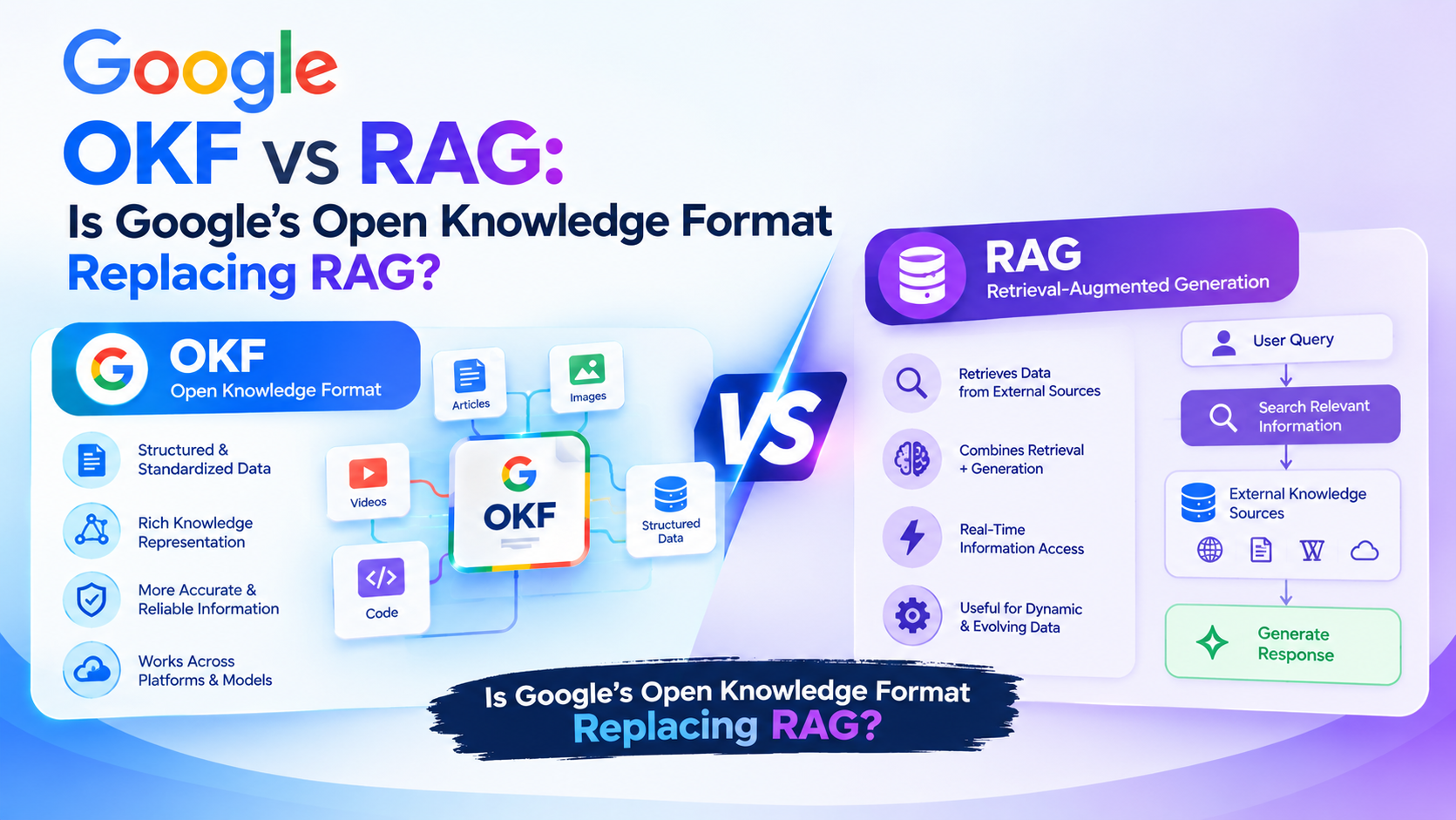
OKF vs RAG has become one of the most discussed topics in the AI engineering community after Google introduced the Open Knowledge Format (OKF) in June 2026. Some online discussions have described OKF as a possible replacement for traditional RAG and vector databases. However, that framing misses an important technical distinction. OKF and RAG are not actually competing technologies designed to solve exactly the same problem. OKF is a format for organizing and representing knowledge, while RAG is an architecture for retrieving information and providing it to an AI model at runtime.
The more interesting question, therefore, is not simply whether OKF will replace RAG. It is how the two technologies can work together. OKF can provide a cleaner, structured and portable knowledge source, while RAG can retrieve the relevant information from a large knowledge base when an AI application needs it. Google’s latest OKF v0.2 also adds trust-related concepts such as provenance, verification, freshness, lifecycle and attestation, making the discussion even more relevant for AI agents.
What Is OKF?
The Open Knowledge Format (OKF) is an open, human- and agent-friendly specification created by Google Cloud for representing the metadata, context and curated knowledge surrounding data and systems.
The format is intentionally simple. OKF v0.2 uses directories containing Markdown files with YAML frontmatter. It does not require a proprietary runtime, central schema registry or specialized SDK. This means knowledge can be stored, read, edited and version-controlled using familiar tools such as Git.
What Is RAG?
Retrieval-Augmented Generation (RAG) is an AI architecture that allows a language model to retrieve external information before generating an answer.
In a typical RAG system, documents are collected, divided into chunks and indexed. Depending on the architecture, those chunks can be represented using embeddings and searched through a vector database, while keyword, metadata or hybrid retrieval can also be used. When a user asks a question, the retrieval system finds relevant information and provides it to the AI model as context.
The key difference is therefore simple:
OKF organizes knowledge. RAG retrieves knowledge.
1. OKF and RAG Solve Different Problems
The biggest mistake in the OKF vs RAG discussion is treating them as two versions of the same technology. They operate at different layers of an AI system.
OKF focuses on how knowledge is represented, structured and maintained. It can describe concepts, metadata, relationships and context surrounding business data and systems. RAG focuses on how relevant information is found and delivered to an AI model when a user asks a question.
A simple analogy is a library. OKF is closer to the way books and information are organized and described, while RAG is the mechanism used to find the right information when someone asks a question. Because of this difference, an organization does not necessarily have to choose between OKF and RAG.
2. Traditional RAG Has a Knowledge Quality Problem
RAG can be extremely useful, but retrieval quality depends heavily on the quality of the information being indexed. If an organization feeds a retrieval system outdated documents, duplicate pages, conflicting definitions or poorly structured content, the system can retrieve those problems too.
For example, imagine a company has five documents defining the same business metric differently. A RAG system may retrieve one or more of those documents depending on the query and retrieval strategy. The language model then has to determine which information is correct.
OKF approaches the problem from the knowledge layer. Instead of simply collecting large amounts of content, organizations can maintain curated knowledge in a structured, human-readable format. This does not automatically make an AI system accurate, but it can provide a cleaner source of context for downstream applications.
3. OKF Is Human-Readable While RAG Infrastructure Can Be More Complex
One of OKF's major characteristics is its simplicity. An OKF bundle consists of Markdown files and YAML metadata, which means developers and non-developers can inspect the underlying information directly.
This is different from looking at an embedding index, where the primary representation used for semantic retrieval is not naturally understandable to a human. A vector database is useful infrastructure, but it does not replace the underlying source of truth.
This makes version control another important advantage of OKF. Knowledge can be stored in Git, changes can be reviewed, and teams can track how information has evolved. Google's specification emphasizes that OKF is designed to be portable and readable without specialized tooling.
4. RAG Is Better Suited to Large and Frequently Queried Knowledge Bases
This does not mean OKF eliminates the need for retrieval.
Suppose a company has millions of documents, product manuals, support tickets, research papers and internal records. Loading all of that information directly into an AI model's context window would be impractical. A retrieval architecture can search the larger corpus and return only the information relevant to the current request.
This is where RAG remains highly useful. Retrieval systems can use semantic search, keyword search, metadata filtering, reranking or hybrid techniques to identify relevant information from very large collections. OKF can provide structured source material, but it does not itself define the complete retrieval pipeline. Google's OKF specification is a knowledge representation format, not a replacement for search, embeddings or retrieval infrastructure.
5. OKF Can Work Together With RAG
Instead of asking “OKF or RAG?”, AI engineers may increasingly ask “How can we use OKF with RAG?”
An organization could maintain important business knowledge in OKF bundles. Those bundles could contain definitions, relationships, system descriptions, metadata and other curated context. A downstream RAG system could then index that information and retrieve relevant pieces when an AI agent needs them.
This architecture separates the source knowledge layer from the retrieval layer. Teams can update and review the underlying knowledge while continuing to use retrieval technology to serve that knowledge at scale. This is one of the most practical ways to understand the relationship between OKF and RAG.
6. OKF v0.2 Adds Another Important Layer: Trust
The OKF discussion became more interesting with the release of OKF v0.2. Google added concepts designed to address trust in knowledge, including provenance, verification, freshness, lifecycle and attestation.
This matters because AI agents may increasingly consume and even create knowledge. If an AI agent encounters a piece of information, it is useful to know where that information came from, whether someone verified it, how recently it was updated and what its lifecycle status is.
RAG by itself does not guarantee any of these properties. A retrieval system can retrieve information, but the quality and trustworthiness of the indexed content still need to be managed. In this sense, OKF and similar knowledge-management approaches can address a layer of the AI stack that retrieval alone does not solve.
7. Does OKF Actually Improve RAG Performance?
This is where AI articles and social-media discussions need to be treated carefully.
There is already independent research examining whether representing the same source material in OKF necessarily improves retrieval and answer quality. A 2026 controlled evaluation found that OKF did not outperform a strong conventional retrieval pipeline in its experiment. The study reported that OKF appeared to provide a benefit against a weaker vector-only baseline, but that advantage disappeared when compared with a stronger hybrid system using techniques such as BM25, dense retrieval and reranking.
This does not mean OKF has no value. It means that claims such as “OKF automatically beats RAG” or “OKF eliminates vector databases” are too broad. OKF's strongest value may be its portability, human readability, structure, maintainability and ability to represent curated knowledge—not an automatic improvement in every retrieval benchmark.
8. Will OKF Replace RAG?
Based on what OKF currently defines, it would be inaccurate to say that Google has introduced OKF specifically to replace RAG.
OKF does not define the complete retrieval process. It does not replace embedding models, search engines, vector databases, rerankers or other retrieval mechanisms. Instead, it provides a standardized way of representing knowledge that can potentially feed different AI systems and retrieval architectures.
The future could therefore involve a hybrid architecture. Curated organizational knowledge could be maintained in OKF, while RAG retrieves relevant information from that knowledge base when required. For smaller and focused knowledge sets, an AI agent might sometimes read the relevant OKF content directly without a separate retrieval system.
OKF vs RAG: Quick Comparison
| Feature | OKF | RAG |
|---|---|---|
| What is it? | Knowledge representation format | AI retrieval architecture |
| Main purpose | Organize and package knowledge | Retrieve relevant information for an AI model |
| Primary layer | Knowledge/content layer | Retrieval/application layer |
| Human-readable | Yes | Depends on source content |
| Requires vector database? | No | Not necessarily, but commonly used |
| Uses embeddings? | No, not inherently | Often, but not required |
| Version control | Easy with normal files/Git | More complex because indexes must be maintained |
| Best use case | Curated, structured knowledge | Large external knowledge collections |
| Can work with the other? | Yes | Yes |
| Replaces the other? | No | No |
OKF vs RAG: Which One Should AI Developers Use?
There is no universal winner because they solve different problems.
If you have a small, well-structured collection of organizational knowledge that needs to be portable, readable and easy to maintain, OKF can be useful. It can provide a clean knowledge layer for AI agents without requiring a complicated retrieval infrastructure.
If you have a huge collection of documents and need an AI application to find relevant information dynamically, RAG remains highly useful. And if you need both curated institutional knowledge and large-scale document retrieval, using OKF and RAG together may make more sense than choosing one over the other.
What OKF vs RAG Means for AI Engineers
The OKF discussion highlights an important change in AI engineering. Building an AI application is no longer just about selecting a powerful model and writing a prompt.
Modern AI systems increasingly require context engineering, knowledge management, retrieval, evaluation, tool integration and agent orchestration. Engineers need to think about where knowledge comes from, how it is maintained, how an AI system accesses it and how its reliability can be evaluated.
For AI engineers and developers, understanding both OKF and RAG can therefore be valuable. RAG remains an important architecture for grounding AI applications in external information, while OKF introduces another approach to making the underlying knowledge structured, portable and easier for both humans and agents to consume.
More for your curious side.
Google Gemini 4 Carbon: New AI Model Leads Across Coding, Cybersecurity and Long-Context Benchmarks
Google Gemini 4 Carbon: New AI Model Leads Across Coding, Cybersecurity and Long-Context Benchmarks Google Gemini 4 Carbon is making headlines in the…

Microsoft’s Biggest Exit Offer Ever: 60,000 Employees, Including India
Microsoft has introduced a Voluntary Exit Offer (VEO) that could cover approximately 60,000 employees across the United States, India, the United Kingdom and…

Freshers Read This: IIT Madras Study Says AI Could Shrink Your First Job Options
Every year, lakhs of students in India finish college with one hope: a first job that lets them learn, grow and move up.…