India Launches Three Indigenous AI Models Under IndiaAI Mission: Meet EKA-1, Dhīr 2B and Dhīr 5B
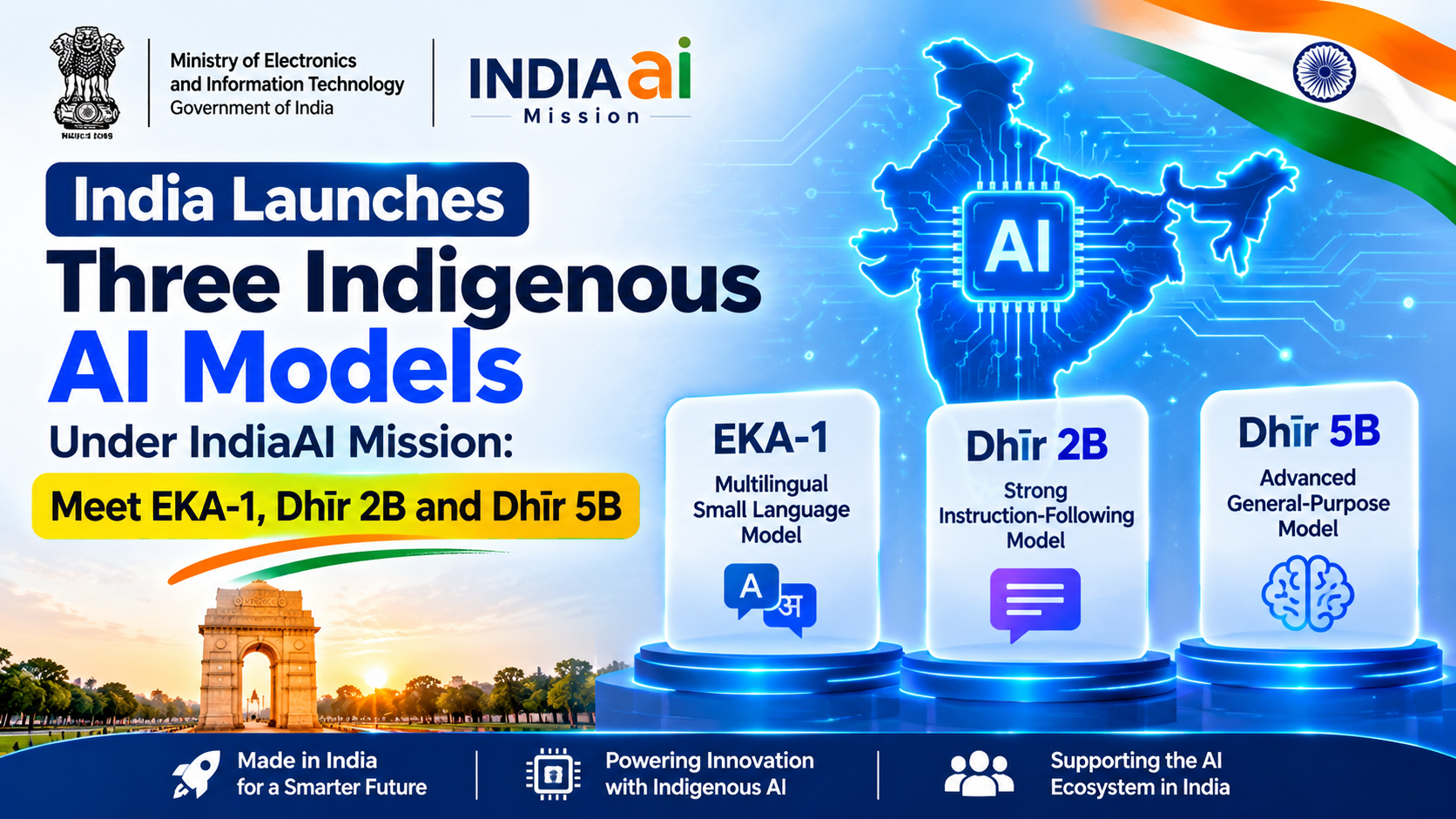
India is moving closer to becoming a major player in the field of artificial intelligence (AI). Three indigenous AI foundation models have been released by the Ministry of Electronics and Information Technology (MeitY) under the Government of India's IndiaAI Mission: EKA-1, Dhīr 2B, and Dhīr 5B. The Indian IT firms ZenteiQ AiTech Innovations and Soket Labs Technology and Research created these models.
On November 3, 2026, the models were introduced in New Delhi. These models handle particular needs such Indian language processing, mathematics, coding, reasoning, document automation, and secure AI deployment, in contrast to AI systems created mostly for general-purpose discussions. Additionally, some are made to operate locally on devices without requiring constant internet access. This could enable Indian consumers, companies, and government agencies to employ AI.
What Are the Three Indigenous AI Models Launched by India?
The three models released under the IndiaAI Mission are:
- EKA-1: Developed by Soket Labs, a 26.3-billion-parameter foundation model designed for mathematics, coding, reasoning and agentic applications. It supports all 22 scheduled Indian languages alongside English.
- Dhīr 2B: Developed by ZenteiQ, a compact multilingual AI model designed for secure, offline-capable and document-based applications.
- Dhīr 5B: Also developed by ZenteiQ, this model provides a larger version of the Dhīr model family for multilingual assistance, information retrieval and automation.
The models were developed under the Foundation Models pillar of the IndiaAI Innovation Centre. The government supported the selected companies with access to subsidised national AI computing infrastructure and assistance for additional research expenses.
8 Key Things to Know About India's New Indigenous AI Models
1. EKA-1: India's 26.3-Billion-Parameter AI Foundation Model
EKA-1 is one of the major highlights of this announcement. Developed by Soket Labs Technology and Research, it is a foundation model featuring 26.3 billion parameters and trained on approximately 7.5 trillion tokens. Parameters are the values a model learns during training to recognise patterns and generate responses. The model has been developed as an open, sparse hybrid language model, with capabilities across all 22 scheduled Indian languages and English.
EKA-1 is designed to handle more than basic text conversations. Its intended capabilities include mathematics, coding, reasoning and agentic use cases. This means it could support applications that require analysing information, solving problems, working with code and carrying out multi-step tasks. According to its developers, the model has been developed with India's banking, financial services and cybersecurity requirements in mind. Source.
2. Dhīr 2B and Dhīr 5B: AI Models Designed for Offline Use
The second major development is the launch of Dhīr 2B and Dhīr 5B by ZenteiQ AiTech Innovations. These are open-source multilingual AI models designed for organisations and individuals who need AI assistance without relying entirely on cloud-based services. Both models support English and 10 Indian languages, making them relevant to multilingual applications in India.
One of their most interesting features is their ability to support on-device deployment. This means the models can run on compatible local hardware, including mobile devices, instead of sending every request to an external cloud server. Their lightweight architecture is intended to make AI functionality accessible in environments where internet connectivity is limited or where organisations prefer to keep sensitive information within their own systems. Source.
3. AI That Can Work Without an Internet Connection
Most popular AI assistants depend on cloud infrastructure. When someone asks a question, the request is generally sent to a remote server, processed and returned as a response. This approach provides access to powerful computing resources, but it also creates challenges for users and organisations with poor connectivity or strict data-security requirements.
Dhīr 2B and Dhīr 5B are designed to address some of these challenges through local deployment. Once downloaded and configured on compatible hardware, users can access supported AI capabilities without needing a continuous internet connection. This could be useful in rural areas, educational institutions, industrial locations and field operations where reliable connectivity is not always available. However, actual performance will depend on the device's hardware, model configuration and the complexity of the task.
4. Focus on Indian Languages and Local Requirements
India has a diverse linguistic environment, and language accessibility remains an important challenge for digital services. AI models that work effectively across Indian languages could help more people interact with technology in the language they understand best.
EKA-1 supports all 22 scheduled Indian languages alongside English, while Dhīr 2B and Dhīr 5B support English and 10 Indian languages. This creates opportunities to build multilingual assistants, document-processing systems and public-facing digital services. However, language support does not automatically mean identical performance across every language. Accuracy, regional variations, speech capabilities and real-world usability will need to be evaluated separately.
5. Potential Applications in Defence, Banking and Cybersecurity
AI is increasingly being used in sectors where organisations process sensitive information and require reliable, controlled technology. Banking, financial services, defence and cybersecurity are among the areas where locally deployable AI models could be valuable.
EKA-1 has been developed with India's banking, financial services and cybersecurity landscape in mind. Meanwhile, the Dhīr models are designed for secure, on-premise deployment and applications across defence, government, industrial and educational sectors. These models could support internal knowledge assistants, document search, information retrieval and workflow automation. Their ability to operate in controlled environments may also make them relevant to organisations that cannot send sensitive data to external AI services.
6. Document Automation and Knowledge Retrieval
Another important application of the Dhīr models is document-grounded automation. Many organisations manage large collections of reports, policies, manuals, records and internal documents. Finding the correct information in these files can take considerable time, particularly when employees need to search across multiple documents.
Document-grounded AI systems can help users retrieve relevant information and automate tasks using an organisation's own knowledge resources. For example, an educational institution could build an assistant that answers questions from its course material, while a company could create an internal assistant to search its operational documents. The Dhīr models are designed to support these types of knowledge retrieval and automation use cases, including in low-connectivity or sensitive environments. Their practical accuracy will depend on how the models are integrated with the documents and how their responses are evaluated.
7. IndiaAI Mission: Government Support for Homegrown AI Development
The launch of these models is part of the broader IndiaAI Mission, approved by the Union Cabinet on March 7, 2024. The mission aims to build an inclusive AI ecosystem in India by supporting infrastructure, research, startups, skills development and responsible AI adoption.
The IndiaAI Mission operates through seven pillars:
- IndiaAI Compute Capacity: Expanding access to computing infrastructure required for AI development.
- IndiaAI Innovation Centre: Supporting the development of indigenous AI models and foundation technologies.
- IndiaAI Datasets Platform (AIKosh): Improving access to datasets and resources for AI development.
- IndiaAI Application Development Initiative: Encouraging AI applications that address real-world challenges.
- IndiaAI FutureSkills: Building AI knowledge and skills among students and professionals.
- IndiaAI Startup Financing: Supporting startups working on AI innovation.
- Safe and Trusted AI: Promoting responsible, reliable and secure AI development.
Soket Labs and ZenteiQ were selected under the IndiaAI Innovation Centre's Foundation Models pillar. Access to subsidised national AI computing infrastructure and research support helped the companies develop their models. This demonstrates how public infrastructure and government support can contribute to domestic AI research and innovation.
8. AIKosh Could Help Researchers and Developers Access These Models
Making AI models available to developers and researchers is an important part of building a larger AI ecosystem. A model can have significant technical capabilities, but its wider impact depends on whether people can access it, experiment with it and develop applications around it.
The government has highlighted AIKosh as a platform through which these models can be made accessible to researchers, students, innovators and the wider public. This could encourage developers to explore practical applications, test model performance and build solutions for Indian requirements. Students and AI researchers may also get opportunities to study indigenous foundation models and experiment with technologies developed by Indian companies. Users should check the relevant AIKosh listings and developer documentation for the latest model access, licensing and deployment instructions.
More for your curious side.
Google Gemini 4 Carbon: New AI Model Leads Across Coding, Cybersecurity and Long-Context Benchmarks
Google Gemini 4 Carbon: New AI Model Leads Across Coding, Cybersecurity and Long-Context Benchmarks Google Gemini 4 Carbon is making headlines in the…

Microsoft’s Biggest Exit Offer Ever: 60,000 Employees, Including India
Microsoft has introduced a Voluntary Exit Offer (VEO) that could cover approximately 60,000 employees across the United States, India, the United Kingdom and…
Freshers Read This: IIT Madras Study Says AI Could Shrink Your First Job Options
Every year, lakhs of students in India finish college with one hope: a first job that lets them learn, grow and move up.…