Google Gemini 4 Argon Launched Globally: What's New, Features, Pricing & Why It Matters
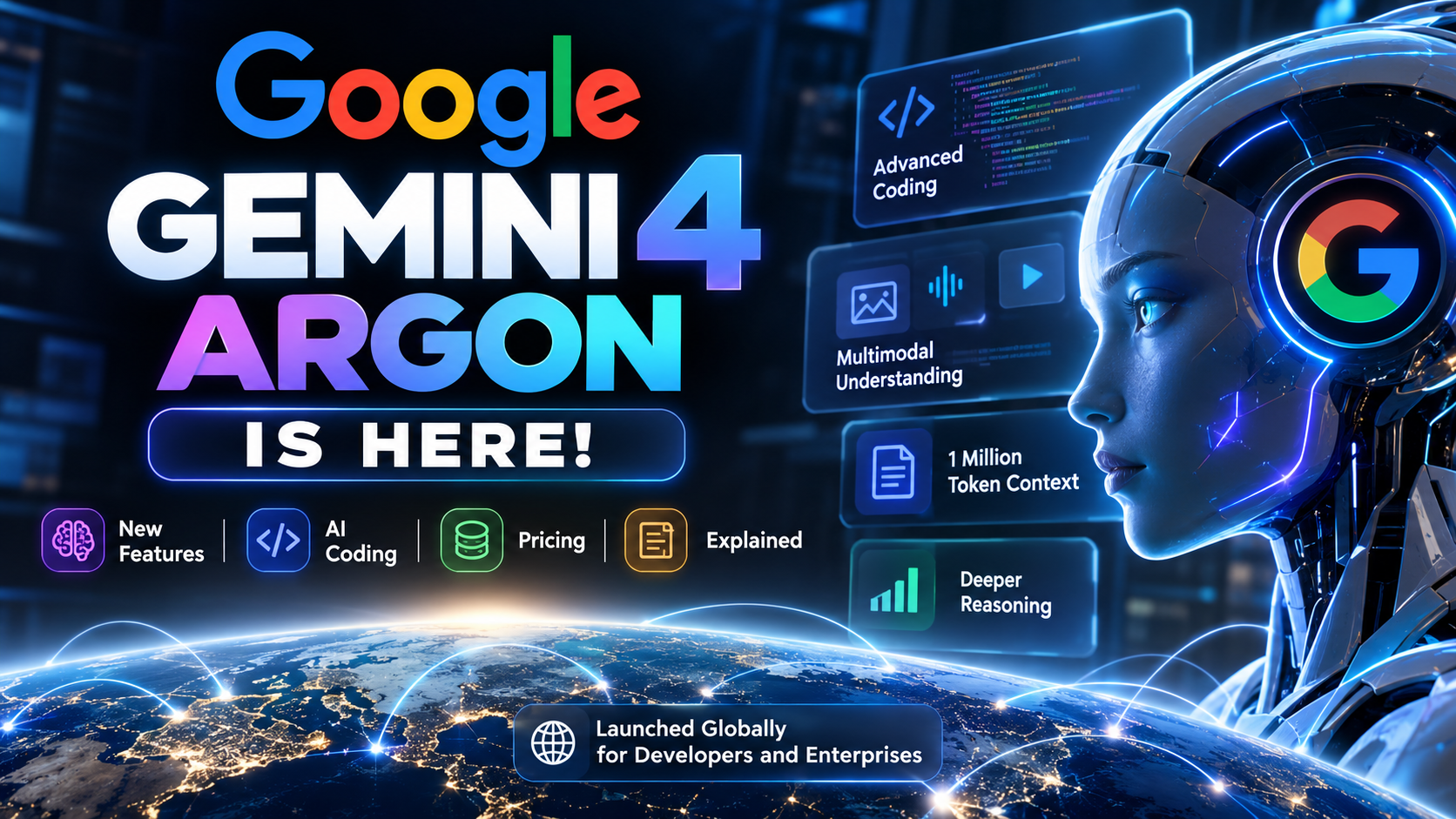
Google Gemini 4 Argon Launched Globally: What's New, Features, Pricing & Why It Matters
Published: October 13, 2026 | Category: AI News | Reading Time: 7 Minutes
Google has officially launched Gemini 4 Argon, its latest advanced AI model, for developers, businesses, researchers, and eligible Google AI subscribers worldwide.
But what exactly is Gemini 4 Argon? Is it just another chatbot upgrade, or does it bring something genuinely new to the AI industry?
The biggest change is that Google is moving beyond AI systems that simply answer questions. Gemini 4 Argon is designed to handle complex problems, work across multiple steps, understand different types of information, and assist with real-world tasks like software development, scientific research, and business analysis.
Let's understand everything in simple language.
What Is Google Gemini 4 Argon?
Gemini 4 Argon is Google's newest flagship AI reasoning model, developed by Google DeepMind.
Think of it as an advanced AI brain that can understand instructions, analyze information, solve problems, write code, and help complete complicated tasks.
For example, imagine you are developing a website.
With a basic AI assistant, you might ask:
"Write HTML code for a login page."
It generates the code, and you handle the remaining development.
With an advanced reasoning model like Gemini 4 Argon, you can give a more complicated instruction:
"Analyze my website project, identify why the login functionality is failing, suggest a secure fix, update the relevant code, and explain how to test it."
When connected to the appropriate development tools, Gemini 4 Argon can help work through multiple parts of that task instead of only generating a small code snippet.
That's the main idea behind this new model: AI that can help solve larger problems, not just generate quick answers.
What's New in Gemini 4 Argon? 7 Major Changes
1. More Powerful Reasoning for Complex Problems
One of Gemini 4 Argon's biggest improvements is its ability to work through difficult, multi-step tasks.
Reasoning means analyzing a problem, connecting information, considering possible solutions, and producing an answer.
For example, suppose a student asks:
"I want to become an AI engineer. Analyze the skills required, create a learning roadmap, recommend projects, and help me prepare for interviews."
Instead of answering only one part, a reasoning model can organize a more detailed plan that connects these requirements.
Google says Argon delivers stronger performance across complex reasoning benchmarks, including a top ranking on the Vals Index, which evaluates AI capabilities in professional fields.
2. Advanced Coding and Software Development
Gemini 4 Argon is especially focused on software engineering.
It can help developers with:
- Writing and explaining code
- Identifying programming errors
- Refactoring existing applications
- Understanding large codebases
- Improving application performance
- Building and testing AI-powered software
Real example from Google:
Google reports that Gemini 4 Argon helped its Chrome engineering team reorganize a legacy code section containing approximately six million lines within the much larger Chromium codebase.
According to Google, this architectural work was completed in weeks rather than the months it would ordinarily require.
This shows how AI-assisted software development is becoming useful for major engineering projects, not just beginner coding exercises.
3. Support for AI Agents and Multi-Step Automation
This is one of the most interesting developments for anyone learning AI.
An AI agent is an AI-powered system that can use tools and carry out a sequence of actions toward a goal.
Let's understand with an example.
Suppose you run an online learning platform and want to analyze student feedback.
A traditional chatbot might summarize feedback that you manually paste into the conversation.
An AI agent powered by an advanced model could potentially:
- Retrieve feedback from an authorized database.
- Categorize common student complaints.
- Identify the most frequently reported problems.
- Generate a summary report.
- Suggest improvements for the platform.
The actual actions depend on which tools, permissions, and integrations are available.
Gemini 4 Argon is designed to support these more complicated agentic workflows.
4. A Huge 1 Million Token Context Limit
Google Gemini 4 Argon supports a unified context limit of approximately 1 million tokens through its API.
But what is a token?
A token is a small unit of text or other information that an AI model processes.
For example, a sentence is divided into smaller pieces that the AI can interpret.
A large context window means the model can work with much more information during a task.
This can be useful for:
- Analyzing lengthy research documents
- Reviewing large software projects
- Understanding extensive reports
- Working with long conversations
- Comparing information across multiple files
The model also supports long-output workflows, subject to API configuration and execution limits.
5. Better Understanding of Images, Audio, Video and Documents
Gemini 4 Argon is a multimodal AI model.
Multimodal AI means an AI system can process more than one type of information.
For example, a student might provide a diagram of a machine-learning architecture and ask the AI to explain it.
A developer might upload screenshots of an application interface and request implementation guidance.
A researcher might provide documents, images, or video material for analysis.
Gemini 4 Argon accepts text, images, audio, video, and PDF inputs through supported interfaces.
However, its direct model output is text; it is not itself an image-generation or audio-generation model.
6. Improvements in Scientific Research and Engineering
Google is also positioning Gemini 4 Argon as a tool for scientific and technical research.
One example involves xTB, an open-source quantum chemistry package used for molecular calculations.
Google says improvements developed with Argon made certain molecular structure predictions up to 2.3 times faster.
Another example involves Google's Agent Development Kit, where Argon-assisted optimizations reportedly reduced in-memory session preparation time by 40%.
These are Google-reported results from specific engineering workloads, not guarantees that every application will experience the same improvements.
7. Stronger Performance in Professional Work
Gemini 4 Argon is designed for complex tasks across fields such as finance, legal work, cybersecurity, science, and business research.
For example, a financial analyst might use the model to examine lengthy reports and identify trends.
A legal professional might use it to organize information from documents before conducting a human review.
A cybersecurity team might use it to assist with authorized security analysis.
The important point is that AI can support these professionals, but high-stakes conclusions still require expert verification.
Gemini 4 Argon vs Traditional AI Chatbots: What's Different?
| Feature | Basic AI Chatbot Tasks | Gemini 4 Argon Capabilities |
|---|---|---|
| Questions | Answer simple questions | Handle complex, multi-step questions |
| Coding | Generate code snippets | Assist with large software engineering tasks |
| Documents | Summarize text | Analyze extensive, multimodal information |
| Automation | Respond to prompts | Support tool-using AI agents |
| Research | Explain known concepts | Assist with advanced research workflows |
| Context | Depends on model | Up to approximately 1 million tokens |
Important: These are illustrative differences between simple chatbot use and Argon's advanced capabilities. Other modern AI models can also perform many of these tasks.
Google Gemini 4 Argon Pricing
Google has announced introductory API pricing for developers and businesses.
| API Usage | Until Nov 30, 2026 | From Dec 1, 2026 |
|---|---|---|
| Input tokens (1 million) | $2 | $4 |
| Output tokens (1 million) | $10 | $20 |
| Cached input tokens (1 million) | $0.10 | $0.20 |
What are input and output tokens?
Input tokens are the information you send to the AI, such as instructions, documents, and conversation context.
Output tokens are the information the AI generates, including billable thinking tokens where applicable.
For example, a developer building an AI application pays based on how many tokens the application processes and generates.
These prices apply to API usage, not ordinary Gemini app subscription fees.
How to Access Gemini 4 Argon
Google is rolling out Gemini 4 Argon across several products.
For students and everyday users:
Eligible Google AI Pro and Ultra subscribers can access Gemini 4 Argon through the Gemini app and AI Mode in Google Search.
For developers:
Developers can work with Gemini 4 Argon using Google AI Studio and the Gemini API, subject to paid-tier access.
The API model identifier is gemini-4-argon.
For businesses:
Organizations can access the model through supported Gemini business and developer platforms.
For coding professionals:
Google AI Ultra subscribers can use Argon through Google Antigravity, Google's AI-powered development environment.
Availability may depend on the product, subscription, account, and rollout status.
Is Gemini 4 Argon Free?
Gemini 4 Argon is not generally available as a free-tier API model.
Google's developer documentation specifies paid-tier access, while Gemini app availability is associated with eligible Pro and Ultra subscriptions.
Students should check their account's available models and subscription options before assuming they can use Argon without payment.
Why Should Students and Freshers Care About Gemini 4 Argon?
You might be thinking:
"I'm not a software engineer or AI researcher. Why should I care about this launch?"
Because developments like Gemini 4 Argon show how the skills needed in the workplace are changing.
AI tools are becoming more capable of supporting programming, analysis, research, documentation, and automation.
For students, this creates an opportunity to learn how to work effectively with these tools.
Here are four areas worth focusing on:
1. Prompt Engineering
Learn how to write clear instructions, provide context, and evaluate AI-generated answers.
2. AI Agents
Understand how AI models connect with tools, APIs, and workflows to perform tasks.
3. Python and APIs
Learn how applications communicate with AI models and how to build useful integrations.
4. Real-World AI Projects
Instead of only watching tutorials, build practical applications such as an AI resume analyzer, document question-answering assistant, or AI-powered study planner.
You do not need to master every AI model. Understanding the fundamentals and building projects is more valuable than simply memorizing model names.
Will Gemini 4 Argon Replace Developers?
Not automatically.
Advanced AI models can automate portions of software development, but creating reliable applications still involves understanding user requirements, architecture, security, testing, deployment, and maintenance.
Developers who know how to use AI tools effectively may become more productive.
For freshers, this means learning programming fundamentals alongside AI-assisted development rather than depending entirely on generated code.
Frequently Asked Questions
What is Google Gemini 4 Argon?
Gemini 4 Argon is Google's flagship reasoning AI model designed for complex tasks such as coding, scientific research, business analysis, and AI agent workflows.
When was Gemini 4 Argon launched?
Google announced its global rollout on October 13, 2026.
Can I use Gemini 4 Argon for coding?
Yes. The model is designed to assist with code generation, debugging, large-codebase analysis, and complex software engineering tasks.
Does Gemini 4 Argon support images and videos?
Yes. It can process text, images, audio, video, and PDF inputs through supported interfaces.
What is the Gemini 4 Argon API price?
The introductory API pricing is $2 per million input tokens and $10 per million output tokens through November 30, 2026. Standard rates are scheduled to double starting December 1, 2026.
Is Gemini 4 Argon better than ChatGPT or Claude?
Google reports strong benchmark results for Gemini 4 Argon, but no single benchmark establishes that one AI model is best for every task. The right choice depends on coding quality, reasoning accuracy, speed, cost, integrations, and the specific application.
Final Thoughts: What Does Gemini 4 Argon Mean for the Future of AI?
Google Gemini 4 Argon represents another important step toward AI systems that can work on longer, more complicated real-world problems.
The most interesting change is not simply that the model can write better answers. It is the growing ability of AI models to assist with software engineering, research, and connected workflows that involve multiple steps.
For students and freshers, the message is simple:
Don't just learn how to use AI chatbots. Learn how AI works, how to build with it, and how to solve real problems using it.
At CommonJobs AI, our goal is to make AI learning practical, affordable, and accessible to the next generation.
Explore AI courses, tools, projects, and learning resources at CommonJobs AI University.
GenZ's Way of Learning.
Sources: Google's official Gemini 4 Argon announcement, Google Gemini API documentation, and Gadgets 360 launch coverage.
More for your curious side.
Google Gemini 4 Carbon: New AI Model Leads Across Coding, Cybersecurity and Long-Context Benchmarks
Google Gemini 4 Carbon: New AI Model Leads Across Coding, Cybersecurity and Long-Context Benchmarks Google Gemini 4 Carbon is making headlines in the…

Microsoft’s Biggest Exit Offer Ever: 60,000 Employees, Including India
Microsoft has introduced a Voluntary Exit Offer (VEO) that could cover approximately 60,000 employees across the United States, India, the United Kingdom and…

Freshers Read This: IIT Madras Study Says AI Could Shrink Your First Job Options
Every year, lakhs of students in India finish college with one hope: a first job that lets them learn, grow and move up.…