10 Best AI Tools for Students in 2026
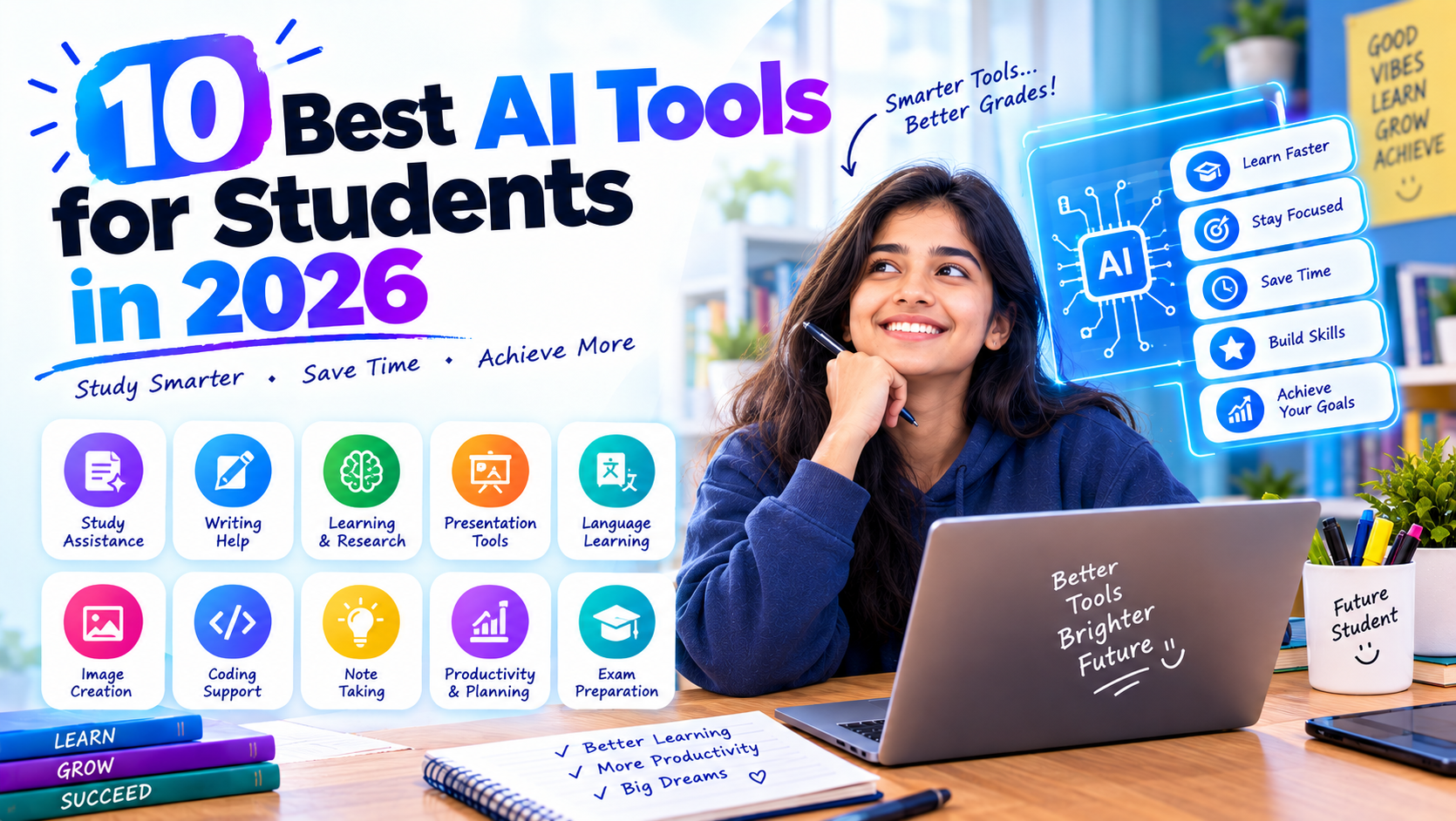
The usage of artificial intelligence in student life is growing. AI solutions can help students learn more effectively and save time by helping them with everything from comprehending challenging academic topics to summarizing study material, making presentations, enhancing writing, taking notes, and learning programming. Instead of depending on these technologies to finish academic work without comprehension, it's crucial to use them as learning aids.
Students will have access to a variety of AI-powered platforms in 2026 that are tailored to meet various academic requirements. While some products concentrate on research, writing, mathematics, presentations, coding, or productivity, others serve as AI teachers. A student's goals will determine which tool is best for them. Used responsibly, AI can make studying more personalized and help students explore subjects beyond the classroom.
What Are AI Tools for Students?
Software programs that employ artificial intelligence to enhance learning, research, writing, problem-solving, productivity, and academic assignments are known as AI tools for students. They can create study questions, clarify ideas, synthesize data, evaluate documents, assist with presentations, and offer feedback.
Teachers, textbooks, and self-directed learning are not replaced by these resources. Alternatively, they might offer extra assistance when students are having trouble with a subject or require assistance with information organization. Students should always double-check crucial information and abide by the AI usage guidelines set forth by their school.
1. ChatGPT
ChatGPT is one of the most versatile AI tools students can use for learning. Students can ask it to explain difficult concepts in simpler language, create practice questions, brainstorm project ideas, summarize notes, generate examples, and work through problems step by step. It can be useful across subjects ranging from computer science and mathematics to business, science, and humanities.
One of the biggest advantages is that students can interact with it conversationally. Instead of simply searching for an answer, a student can ask follow-up questions and request another explanation if the first one is confusing. However, students should verify important academic information because AI can sometimes produce incorrect or incomplete answers.
Best for:
- Concept explanations
- Brainstorming
- Study assistance
- Practice questions
- Coding help
- Writing support
2. Google Gemini
Google Gemini can help students with research, brainstorming, writing, studying, and understanding information. Students can use it to break down complex topics, generate questions for revision, summarize information, and explore different perspectives on a subject.
Its usefulness increases when students provide clear context about what they are studying. For example, a student can ask for an explanation at a beginner level and then progressively request more advanced examples. Like other general-purpose AI systems, students should fact-check important information rather than treating every generated response as automatically correct.
Best for:
- Research assistance
- Studying
- Brainstorming
- Writing
- Concept explanations
- General academic support
3. Perplexity
Perplexity is an AI-powered answer and research tool that combines conversational responses with web-based information and citations. This makes it useful for students who need to explore a topic and identify sources for further reading.
Students can use it to begin research, understand unfamiliar subjects, discover relevant sources, and compare information. It is still important to open and evaluate the underlying sources rather than relying entirely on an AI-generated summary. For academic assignments, students should follow their institution's citation requirements and use original sources wherever appropriate.
Best for:
- Research
- Source discovery
- Current information
- Topic exploration
- Research questions
4. Grammarly
Grammarly is an AI-powered writing assistant that can help students improve grammar, spelling, clarity, tone, and overall writing quality. It can be useful when preparing essays, reports, emails, applications, project documentation, and other academic writing.
The tool is most useful when students use its suggestions as feedback about their writing. Rather than accepting every suggestion automatically, students can learn from corrections and understand why certain sentences are unclear or grammatically incorrect. This makes AI writing assistance useful as part of the learning process.
Best for:
- Grammar
- Essay editing
- Academic writing
- Clarity
- Proofreading
- Writing improvement
5. NotebookLM
NotebookLM is an AI-powered research and study tool that allows users to work with their own sources. Students can provide relevant documents and use the tool to understand and interact with the material.
This can be useful when preparing for exams or working on research projects involving multiple documents. Instead of repeatedly searching through lengthy material, students can use AI assistance to identify important information, generate study resources, and ask questions about the provided sources. Students should still check the original documents when accuracy is important.
Best for:
- Study notes
- Research documents
- Document analysis
- Exam preparation
- Source-based learning
6. Canva
Canva is a popular design platform that students can use to create presentations, posters, infographics, reports, videos, resumes, and other visual projects. Its AI-powered features can speed up parts of the design and content-creation process.
For students who are not experienced with graphic design, Canva can make academic projects easier to present professionally. Students can start with templates and customize them for their assignments. However, the final presentation should reflect the student's own understanding and comply with any requirements provided by the teacher or institution.
Best for:
- Presentations
- Posters
- Infographics
- Project designs
- Visual learning
- Academic presentations
7. Wolfram|Alpha
Wolfram|Alpha is a computational knowledge engine that can be particularly useful for mathematics, science, engineering, and quantitative subjects. It can perform calculations and provide structured information for a wide range of mathematical and scientific problems.
For students, its value goes beyond obtaining an answer. It can help them explore mathematical concepts, check calculations, and understand relationships between variables. Students should use computational tools to support their learning rather than simply copying final answers without understanding the underlying method.
Best for:
- Mathematics
- Calculations
- Science
- Engineering
- Data analysis
- Problem checking
8. GitHub Copilot
GitHub Copilot is an AI coding assistant designed to help developers write and understand code. For computer science and programming students, it can assist with code suggestions, explanations, debugging, and exploring programming concepts.
Students can use coding assistants while learning languages such as Python, JavaScript, Java, and others. The important point is to understand the generated code instead of submitting it without review. Writing code independently and then using AI to explain or debug it can be a useful way to develop programming skills.
Best for:
- Programming
- Debugging
- Code explanations
- Software projects
- Learning programming
9. Quizlet
Quizlet is a learning platform that provides digital study tools such as flashcards, practice activities, and study resources. Its AI-powered features can help students turn learning material into study activities and practice questions.
This can be particularly useful for memorization-heavy subjects. Students can use flashcards to revise definitions, formulas, terminology, historical events, vocabulary, and other information. AI-generated study material should still be checked against reliable class notes or textbooks to make sure the information is correct.
Best for:
- Flashcards
- Revision
- Memorization
- Practice questions
- Exam preparation
10. Notion AI
Notion AI combines AI assistance with a workspace for notes, documents, projects, and task management. Students can use it to organize class notes, summarize information, brainstorm ideas, create study plans, and manage academic projects.
Its productivity-focused approach makes it useful for students who have multiple subjects and assignments to manage. Instead of keeping study notes, deadlines, project information, and planning in separate applications, students can organize much of their academic workflow in one workspace.
Best for:
- Note-taking
- Study planning
- Project management
- Summarization
- Organization
- Productivity
How AI Is Changing Student Learning in 2026
AI is advancing education beyond the conventional approach of reading a textbook and looking for solutions. Students can now communicate with AI tutors, ask follow-up questions, create practice materials, examine papers, and get quick help with a variety of learning tasks.
Personalized learning is the greatest opportunity. An AI tool can provide a more straightforward explanation, examples, analogies, or practice questions to a learner who is having trouble understanding a certain idea. More complex problems can be requested by another student who is already familiar with the fundamentals. This adaptability can enhance learning in the classroom.
How Students Should Use AI Responsibly
1. Use AI to Understand, Not Just Copy
Ask AI to explain concepts, provide examples, create practice questions, or identify mistakes. This encourages learning instead of simply producing answers.
2. Verify Important Information
AI tools can make mistakes or provide outdated information. Check important facts using textbooks, academic papers, official sources, or trusted educational resources.
3. Follow Academic Policies
Different schools, colleges, and universities may have different rules regarding AI-generated content. Students should understand and follow the rules that apply to their assignments and examinations.
4. Protect Personal Information
Students should avoid entering sensitive personal information, private academic records, passwords, or confidential documents into AI tools without understanding how that information is handled.
5. Keep Developing Your Own Skills
AI can make tasks easier, but students still need fundamental skills such as writing, mathematics, critical thinking, research, communication, and programming.
Benefits of AI Tools for Students
AI tools can give students quicker access to explanations, practice questions, writing criticism, help with their research, and productivity boosts. Additionally, they can assist students in organizing vast volumes of data and dividing complex topics into digestible chunks.
Accessibility is an additional advantage. With AI, students don't have to worry about asking the same question over and over. This can increase the flexibility and personalization of independent study when used properly.
Limitations of AI for Students
Teachers, textbooks, and real learning cannot be replaced by AI. Artificial intelligence (AI) systems have the potential to provide misleading information, misinterpret queries, or offer convincing but false explanations.
Additionally, if students use AI for every task and issue, they risk becoming unduly reliant on it. Instead than weakening autonomous thought and problem-solving abilities, the objective should be to employ AI to improve learning.
More for your curious side.
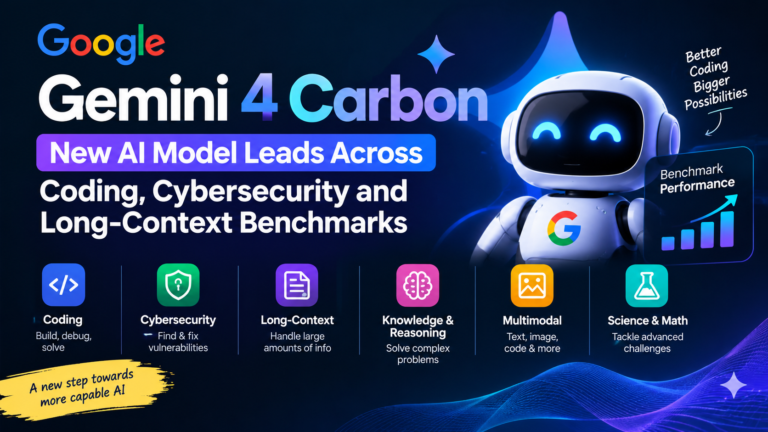
Google Gemini 4 Carbon: New AI Model Leads Across Coding, Cybersecurity and Long-Context Benchmarks
Google Gemini 4 Carbon: New AI Model Leads Across Coding, Cybersecurity and Long-Context Benchmarks Google Gemini 4 Carbon is making headlines in the…

Microsoft’s Biggest Exit Offer Ever: 60,000 Employees, Including India
Microsoft has introduced a Voluntary Exit Offer (VEO) that could cover approximately 60,000 employees across the United States, India, the United Kingdom and…

Freshers Read This: IIT Madras Study Says AI Could Shrink Your First Job Options
Every year, lakhs of students in India finish college with one hope: a first job that lets them learn, grow and move up.…