10 Best AI Tools for Marketing in 2026
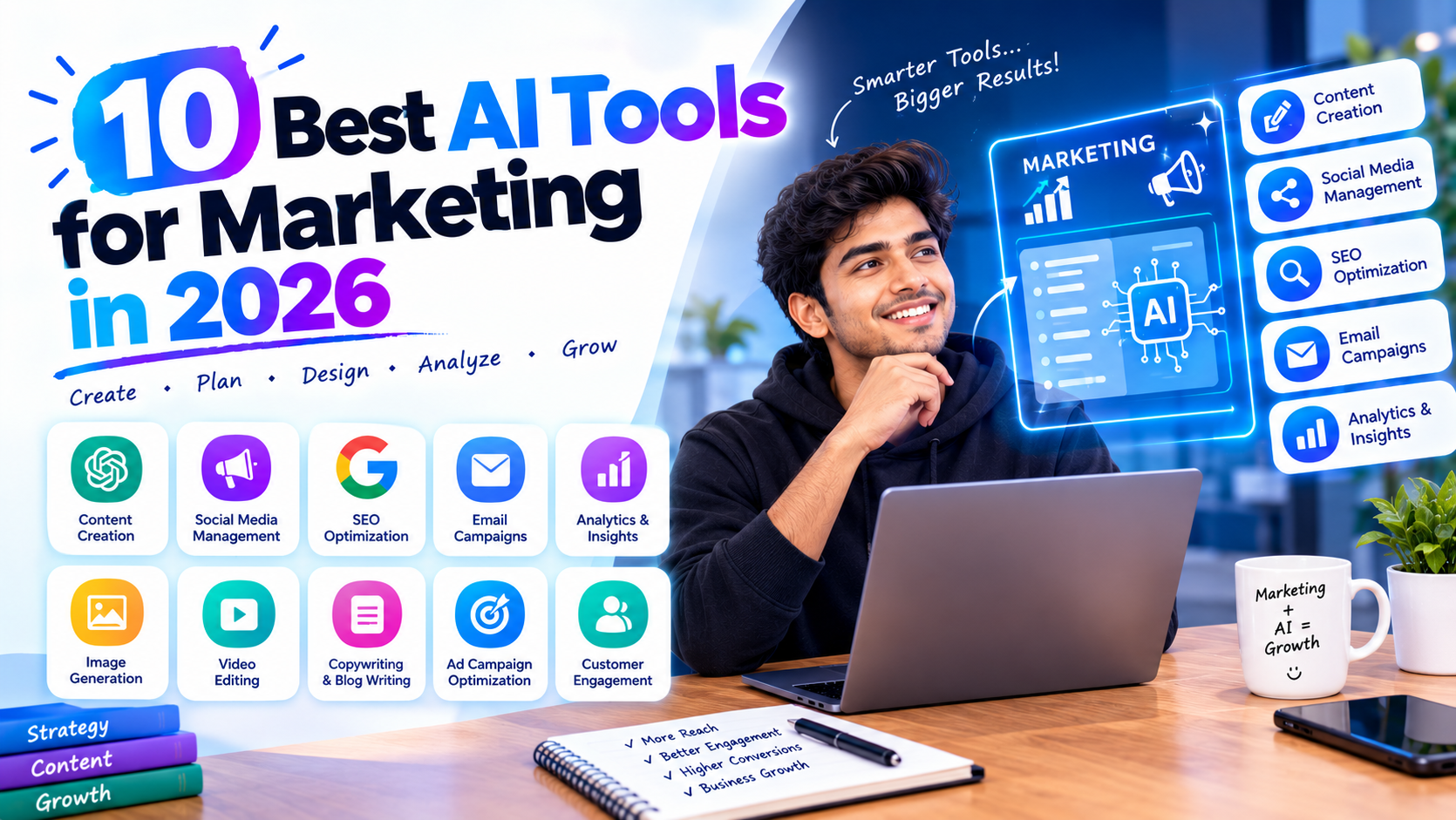
The way companies design, develop, and carry out marketing campaigns is being transformed by artificial intelligence. AI-powered tools may now assist with tasks that formerly required hours of research, writing, design, analysis, and optimization. AI is being incorporated into everyday marketing processes for startups, agencies, creators, and big companies, from creating marketing content to evaluating consumer behavior.
The greatest benefit of AI for marketing goes beyond just producing content more quickly. Teams may better analyze audiences, tailor campaigns, spot opportunities, optimize material for search engines, produce visualizations, and automate tedious operations with the aid of contemporary AI marketing solutions. To create successful advertisements, marketers still require human creativity, strategy, brand awareness, and fact-checking.
What Are AI Marketing Tools?
Software platforms that employ artificial intelligence to assist various aspects of the marketing process are known as AI marketing tools. They can help with content creation, SEO, social media management, advertising, email campaigns, customer research, design, analytics, and marketing automation, depending on the instrument.
Marketers can create a whole process around several specialized tools rather than use AI for a single activity. One platform may be used by a content team for writing, another for social media, another for SEO research, and still another for producing graphic assets.
1. ChatGPT
ChatGPT is one of the most versatile AI tools available to marketers. It can assist with brainstorming campaign ideas, creating content outlines, writing social media captions, developing email drafts, generating ad-copy variations, researching audiences, and turning long-form content into multiple marketing assets. Marketers can also use it to develop content calendars and brainstorm different approaches to a campaign.
Its flexibility makes it useful across almost every stage of marketing. For example, a marketer can provide a target audience, product information, brand tone, and campaign objective and ask AI to generate several content concepts. The output should still be reviewed and adapted by a human because effective marketing requires brand knowledge, originality, factual accuracy, and an understanding of the target audience.
Best for:
- Content ideation
- Copywriting
- Campaign brainstorming
- Social media content
- Email marketing
- Marketing research
2. Canva
Canva is a visual design platform that has increasingly integrated AI into the creative process. Marketers can use it to create social media posts, presentations, advertisements, banners, videos, infographics, and other branded content. AI-powered features can help users generate designs and accelerate parts of the creative workflow.
This is especially useful for small businesses and marketing teams that need a large amount of visual content but do not have a dedicated designer for every campaign. Marketers can create a basic concept and then customize fonts, layouts, images, colors, and branding. Human review remains important because marketing visuals need to maintain consistent brand identity across different channels.
Best for:
- Social media graphics
- Marketing presentations
- Advertisements
- Videos
- Brand content
- Visual campaigns
3. Jasper
Jasper is an AI platform focused heavily on marketing and content creation. It can help marketing teams create blog content, advertising copy, social media content, email campaigns, product descriptions, and other marketing materials.
One of its major advantages is its marketing-oriented workflow. Instead of treating AI as a general chatbot, Jasper is designed around business content and marketing use cases. Teams can use it to accelerate content production while maintaining a consistent brand voice. Marketers should still provide clear brand guidelines and review generated content before publishing.
Best for:
- Marketing copy
- Blog content
- Social media
- Advertising
- Brand voice
- Content marketing
4. HubSpot
HubSpot combines CRM, marketing, sales, customer service, and automation capabilities, with AI features integrated across its platform. Marketers can use HubSpot's AI capabilities to assist with content creation, customer communication, campaign workflows, and other marketing activities.
The major benefit is the connection between marketing activities and customer data within a broader business platform. Instead of treating content creation, lead management, and customer communication as completely separate processes, businesses can use an integrated system. This can help marketing teams manage campaigns more efficiently, although organizations should carefully configure automation and review customer-facing communications.
Best for:
- Marketing automation
- CRM
- Email campaigns
- Lead management
- Content creation
- Customer engagement
5. Semrush
Semrush is a well-known digital marketing and SEO platform that uses AI and automation across several marketing workflows. Marketers can use it for keyword research, competitor analysis, content optimization, SEO analysis, and broader digital marketing research.
For content marketers, tools in the Semrush ecosystem can help identify topics and search opportunities and provide recommendations for improving content. It can also help marketers understand competitors and monitor search performance. However, SEO tools should support strategy rather than replace it. Search intent, audience needs, originality, and content quality still require human judgment.
Best for:
- SEO
- Keyword research
- Competitor research
- Content optimization
- Search marketing
- Digital marketing analysis
6. Grammarly
Grammarly uses AI to help users improve written communication. Marketing teams can use it to check grammar, spelling, clarity, tone, and overall writing quality across emails, social posts, website copy, and other marketing materials.
For marketers producing content across multiple channels, maintaining clear and professional communication is important. Grammarly can act as a final writing assistant before content is published or sent to customers. It should not replace the marketer's understanding of brand voice, because a grammatically perfect sentence may still be unsuitable for a particular audience or campaign.
Best for:
- Editing
- Marketing copy
- Email writing
- Social media
- Grammar checking
- Brand communication
7. Surfer
Surfer is an SEO and content optimization platform designed to help marketers create content that is better aligned with search intent and relevant search results. Its tools can provide recommendations related to keywords, content structure, and optimization.
This can be useful for marketers who publish blogs and other organic-search content. Instead of relying only on intuition, content teams can use data-driven recommendations while creating or updating pages. However, optimization should not turn content into a collection of keywords. The primary goal should remain useful, accurate, and readable information for the target audience.
Best for:
- SEO content
- Content optimization
- Keyword research
- Blog optimization
- Organic search strategy
8. Hootsuite
Hootsuite is a social media management platform that has incorporated AI capabilities into its workflow. Marketers can use the platform to manage social content, schedule posts, monitor social activity, and use AI assistance for aspects of content creation.
For businesses managing multiple social media accounts, this can reduce repetitive work. Instead of creating and managing every post manually, teams can organize campaigns and publishing schedules in one environment. AI can help with ideas and content variations, but marketers should still review posts to ensure they are timely, accurate, and appropriate for the platform and audience.
Best for:
- Social media management
- Content scheduling
- Social campaigns
- Social monitoring
- Content ideas
9. Mailchimp
Mailchimp is an email marketing and marketing automation platform that incorporates AI-powered capabilities into its tools. Marketers can use it to create email campaigns, manage audiences, automate communications, and improve different aspects of email marketing.
AI can make email marketing more efficient by helping marketers generate content and optimize parts of a campaign. The real value of email marketing, however, comes from understanding the audience and sending relevant information at the right time. Businesses should therefore combine automation with audience segmentation, testing, and human oversight.
Best for:
- Email marketing
- Marketing automation
- Customer communication
- Campaign management
- Audience management
10. AdCreative.ai
AdCreative.ai focuses on AI-assisted advertising creative. It can help marketers generate advertising concepts and creative variations for digital campaigns, making it easier to test different messaging and visual approaches.
This can be particularly useful for businesses running multiple paid advertising campaigns. Instead of relying on a single creative, marketers can explore different versions and evaluate their performance. AI-generated advertising assets should still follow brand guidelines and advertising policies, and performance data should ultimately determine which creative approaches deserve further testing.
Best for:
- Advertising creatives
- Digital advertising
- Ad variations
- Campaign testing
- Performance marketing
How AI Is Changing Marketing in 2026
AI is increasing the speed and scalability of marketing procedures. AI may now be used by a small marketing team to handle social media, make images, evaluate keywords, brainstorm content, produce initial drafts, and automate customer communications.
The ability to link various activities is the more significant change. With the use of several AI tools, a marketer may transform a single campaign idea into a blog post, social media content, email campaign, advertisement, and visual assets. Teams may now devote more time to strategy, creative direction, consumer comprehension, and campaign optimization.
How to Use AI Marketing Tools Effectively
1. Start With a Clear Marketing Goal
Before choosing an AI tool, define what you want to achieve. Your objective could be increasing website traffic, generating leads, improving social engagement, increasing conversions, or building brand awareness.
2. Give AI Better Context
AI outputs become more useful when you provide relevant information such as your target audience, industry, product, brand voice, campaign objective, and platform.
3. Use Multiple Tools Strategically
You do not need to use every AI marketing platform. Choose tools based on your workflow. For example, one tool may handle SEO while another supports visual design and another manages email campaigns.
4. Review AI-Generated Content
AI can make factual, grammatical, contextual, or brand-related mistakes. Every customer-facing piece of content should be reviewed before publication.
5. Measure Results
AI-generated content is not automatically effective marketing. Track metrics such as traffic, engagement, leads, conversions, click-through rates, and return on advertising spend to understand what actually works.
Benefits of AI Tools for Marketing
Teams can create content more rapidly and with less repetitive effort thanks to AI marketing tools. Additionally, they can offer data-driven suggestions that would normally necessitate extensive manual investigation.
AI can increase the accessibility of professional marketing operations for small enterprises. Instead of needing a big specialist department for every task, a small team may handle social media, make images, optimize websites, execute email campaigns, and create content.
Limitations of AI Marketing Tools
AI cannot take the place of creative judgment, customer insight, or marketing strategy. Although it may produce content, it does not inherently comprehend every aspect of a business's positioning, audience, culture, or competitive landscape.
Additionally, when marketers rely too much on AI, they run the risk of creating generic content. AI should be used by businesses as a helper while incorporating unique insights, actual consumer experiences, expert knowledge, and a unique brand voice.
More for your curious side.
Google Gemini 4 Carbon: New AI Model Leads Across Coding, Cybersecurity and Long-Context Benchmarks
Google Gemini 4 Carbon: New AI Model Leads Across Coding, Cybersecurity and Long-Context Benchmarks Google Gemini 4 Carbon is making headlines in the…

Microsoft’s Biggest Exit Offer Ever: 60,000 Employees, Including India
Microsoft has introduced a Voluntary Exit Offer (VEO) that could cover approximately 60,000 employees across the United States, India, the United Kingdom and…

Freshers Read This: IIT Madras Study Says AI Could Shrink Your First Job Options
Every year, lakhs of students in India finish college with one hope: a first job that lets them learn, grow and move up.…