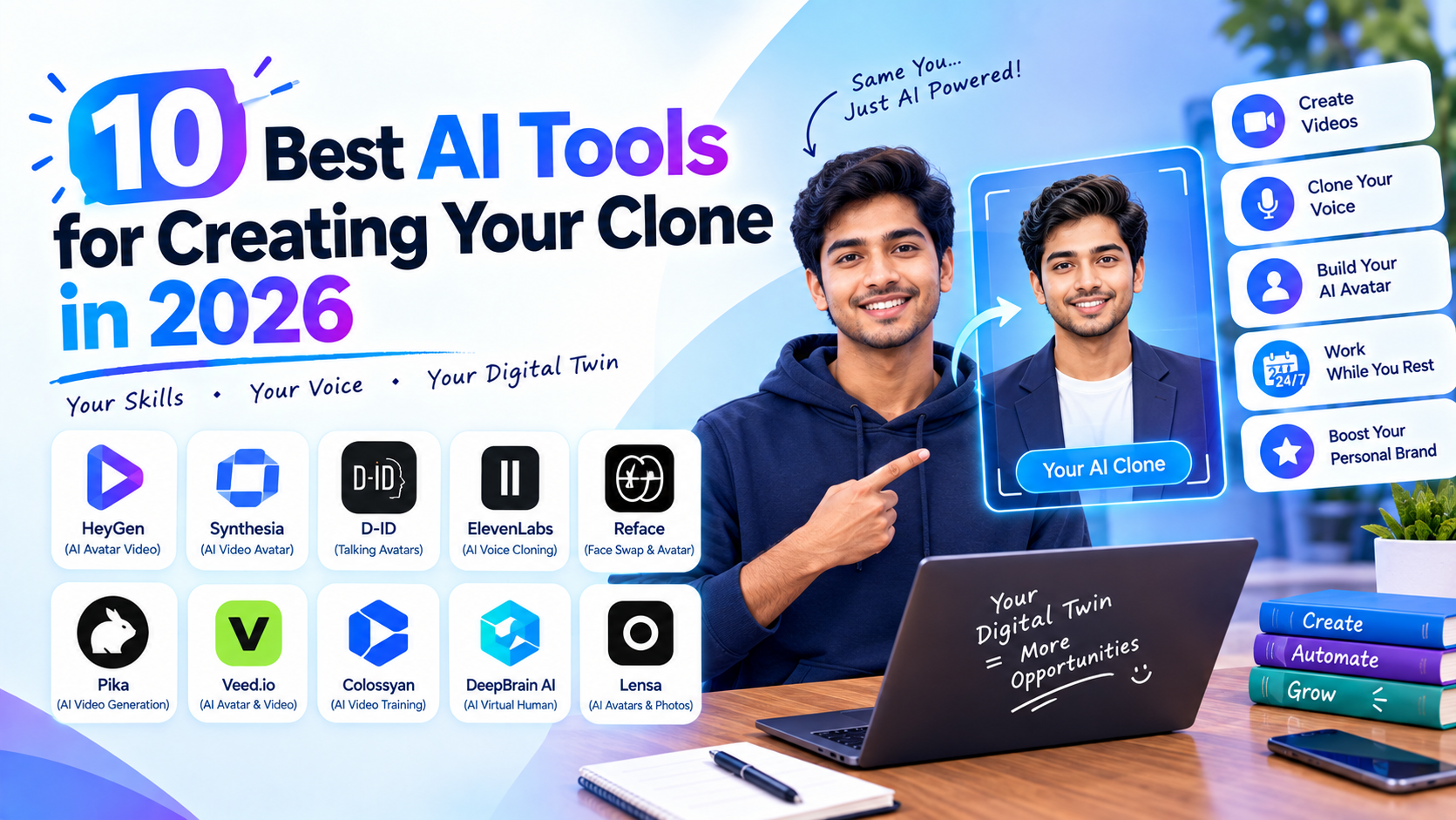
10 Best AI Tools for Creating Your Clone in 2026
The potential to build an AI clone of oneself is one of the most intriguing advancements in artificial intelligence, which is transforming the way humans produce digital material. Artists and professionals can employ AI avatars and voice-cloning technology to create digital copies of themselves that can deliver scripted content, eliminating the need to manually record every video, presentation, or training session.
Content producers, educators, recruiters, marketers, entrepreneurs, and companies can all benefit from AI clones. Depending on the platform, users can make a digital avatar that resembles them, mimic their voice, turn text into movies, and even develop material in many languages. This can drastically cut down on the amount of time needed to produce repeating videos.
An AI clone should be developed and applied sensibly, though. Only their own face or voice should be cloned, or the person being represented should be given the proper consent. When appropriate, AI-generated content should also be disclosed, especially if viewers could plausibly mistake a synthetic voice or video for an authentic recording.
1. HeyGen
One popular AI video platform for producing AI-generated videos and digital avatars is HeyGen. By using a script, users can produce videos after creating an avatar that reflects them. Presentations, instructional videos, marketing content, and social media videos may be created using the platform without having to physically record each version.
Making a reusable digital presenter is one of its practical uses. By altering the script, a creator might record or make an avatar once and then utilize it for several videos. Businesses that frequently require product explainers or content producers that consistently release instructional materials may find this helpful. Additionally, HeyGen has multilingual features that enable users to produce localized video content.
2. Synthesia
Synthesia is an AI platform for creating videos that presents scripted content using artificial avatars. It is especially well-liked for business, instructional, and training videos when companies need reliable presenters without having to start from scratch.
Users can write a script, choose an avatar, and produce a polished video. This method can be used by organizations for internal communications, product education, onboarding, and employee training. Additionally, companies can produce videos in several languages, which can eliminate the need for distinct recording sessions for various consumers.
3. D-ID
D-ID specializes in using digital humans to create AI-generated video. The technology can create videos from text and other inputs and turn images into talking digital presenters.
For artists who wish to experiment with digital characters or transform a portrait into a talking avatar, this can be helpful. AI presenters can also be used by businesses for marketing, customer service, and instructional materials. The technology shows how a static image may be converted into a digital experience that is more engaging.
4. Tavus
Tavus specializes in digital reproductions and customized AI video production. Its technology enables companies and individuals to produce AI-generated movies that can be tailored for various audiences or contexts.
Personalized communication is one significant use case. A company can employ an AI-generated presenter and dynamically modify portions of the message rather than creating hundreds of separate films. This can be helpful for marketing strategies that prioritize personalization, customer communication, and sales outreach.
5. Synthesys
AI avatars and speech technologies for video production are features of Synthesys, an AI content-generation platform. Presenter-led material can be produced by users without the need for a conventional recording setup.
This can make it easier for companies and artists to produce training materials, presentations, and explainer videos. Using an AI presenter and a script, users may produce content without having to set up cameras, microphones, and lighting for each video. When businesses need to provide a lot of educational content, this can be quite helpful.
6. Colossyan
Colossyan is an AI video platform with a heavy emphasis on communication, training, and learning in the workplace. With AI presenters and scripts, users may produce videos.
Organizations who need to provide instructional materials and employee training on a large scale may find the platform helpful. Teams can edit the script and create a new version of the video instead of recording a presenter each time corporate policies or training materials change. This may facilitate the upkeep of repeating training materials.
7. Elai.io
Elai.io is an AI platform that lets people make videos with textual screenplays and artificial avatars. It is intended for corporate communication, instruction, training, and presentations.
Without having to videotape themselves, users can transform written content into presenter-led videos. Professionals and educators that have a lot of written content but wish to turn it into video may find this helpful. Throughout a sequence of movies, AI avatars can offer a consistent visual presenter.
8. Hour One
The AI video platform Hour One is based on simulated human presenters. It enables businesses to produce videos with scripted content and AI-generated presenters.
The platform can be used by businesses for professional content such as onboarding, internal communication, and training. For a regular educational series, a business may develop a virtual presenter and update the scripts as new information becomes available. The logistical work involved in traditional video production can be decreased with this method.
9. Rephrase.ai
Rephrase.ai is an AI video platform that produces customized video content using synthetic voices and digital avatars. Applications pertaining to marketing, communication, and customized client experiences have made use of it.
When a company wishes to convey various messages to various audiences, the capacity to create customized films might be helpful. Organizations can use predetermined scripts and data to build AI-generated versions rather than manually documenting each version. This may contribute to the scalability of visual communication.
10. VEED AI
VEED is a platform for online video editing that also offers AI-powered video production. While its wider editing environment enables users to improve the end product, its AI functions can help in creating and editing videos.
Having editing features in the same workflow can be helpful for someone making an AI clone or avatar video. Subtitles, images, music, screen recordings, and other visual components can be combined with spoken content or presenters created by AI. Because of this, VEED is especially helpful for designers who require both conventional video editing capabilities and AI support.
How AI Clones Actually Work
In order to create an AI clone, multiple technologies must cooperate. The first is the creation of digital avatars, which provide a picture of an individual. The second is voice synthesis, often known as voice cloning, which aims to replicate a person's speech patterns. The third is generative AI, which creates verbal and visual material from a written script.
The precise procedure varies depending on the platform. In order for the system to generate a customized avatar, several services ask users to videotape themselves. Others can utilize pre-made digital beings or make avatars from pictures. Before they can produce synthetic speech, voice-cloning algorithms might need a voice recording sample.
The end product is a digital representation that can convey information without having the subject to appear in front of a camera for each recording.
Why Are AI Clones Becoming Popular?
Content scalability is one of the main causes. There is a daily cap on the amount of videos that can be recorded. It may be possible for an AI avatar to produce several iterations of a script without the user having to repeat the same recording.
To explain repeated course topics, for instance, a teacher could develop an AI version of themselves. A business creator could make films that address common queries. The same digital presenter might be used by a marketing team to produce localized campaigns.
As a result, AI clones can minimize monotonous production tasks while preserving an identifiable online presence.
AI Clones for Content Creators
AI avatars allow content producers to experiment with various kinds of video content. For some content, artists can utilize an avatar instead of being on camera, saving real recordings for videos where a person's presence is crucial.
AI-generated voices and avatars can also be used by creators to produce content in many languages. Without requiring the creator to become proficient in every target language, this might potentially increase the audience.
Authenticity is still crucial, though. Instead of totally replacing authentic audience contact, an AI clone should enhance a creator's true identity.
AI Clones for Businesses
Digital clones can be used by businesses for customer education, marketing, product demos, onboarding, and employee training.
A business might, for instance, make a digital presenter to describe how its software operates. Instead of setting up another filming session, the corporation can update the script and regenerate the video whenever the product changes.
Large firms that have hundreds of training or instructional videos to keep may find this especially helpful.
Important Risks and Ethical Considerations
AI cloning technology poses significant concerns as well. Users should never clone someone without the proper authority because a person's voice and face are strongly linked to their identity.
Additionally, audiences could be misled. A synthetic video that looks and sounds like a real person could potentially be mistaken for an authentic recording. Therefore, when releasing AI-generated content, organizations should take disclosure and openness into account.
AI clones shouldn't be utilized to mimic real individuals, trick audiences, produce fake communications, or misrepresent claims made by real people.
More for your curious side.
Google Gemini 4 Carbon: New AI Model Leads Across Coding, Cybersecurity and Long-Context Benchmarks
Google Gemini 4 Carbon: New AI Model Leads Across Coding, Cybersecurity and Long-Context Benchmarks Google Gemini 4 Carbon is making headlines in the…

Microsoft’s Biggest Exit Offer Ever: 60,000 Employees, Including India
Microsoft has introduced a Voluntary Exit Offer (VEO) that could cover approximately 60,000 employees across the United States, India, the United Kingdom and…
Freshers Read This: IIT Madras Study Says AI Could Shrink Your First Job Options
Every year, lakhs of students in India finish college with one hope: a first job that lets them learn, grow and move up.…