OpenAI Launches Dots: The New Always-On AI Agents That Can Work for You
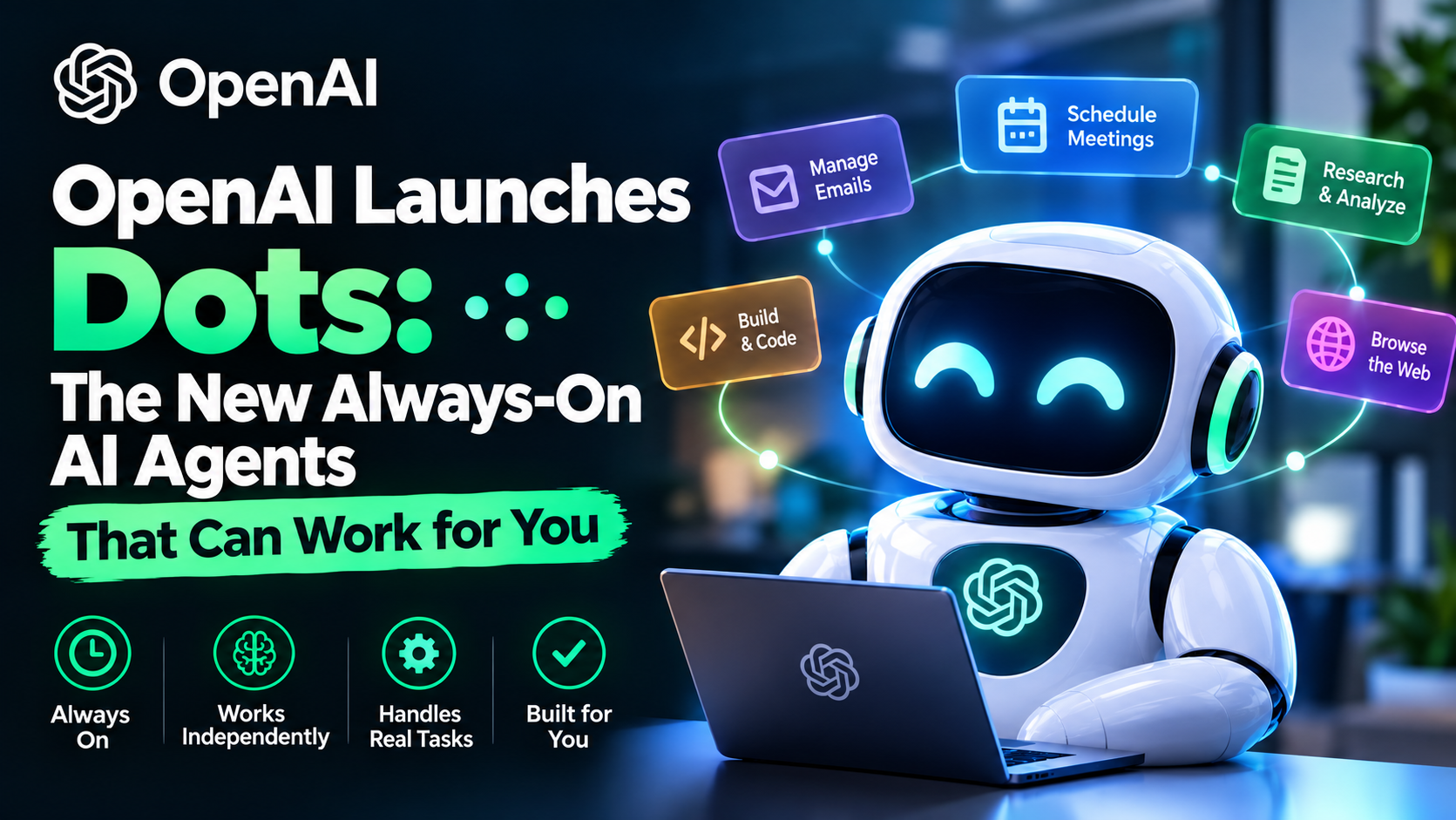
With the introduction of Dots, a novel kind of always-on AI agent unveiled during OpenAI's DevDay on September 29, 2026, OpenAI has taken yet another significant step toward agentic AI. Dots are intended to handle ongoing tasks, operate in the background, communicate with software, and provide updates or finished work to the user, as contrast to a standard chatbot that waits for a user to deliver a prompt. According to OpenAI, Dots are agents that are capable of working continually on behalf of a user instead than only responding to inquiries.
The launch is noteworthy because it shifts ChatGPT away from the conventional Q&A model and toward AI that is capable of doing tasks. Dots are capable of using a web browser and related apps, working with tools, maintaining context throughout lengthier tasks, and operating with their own cloud computer. Dots can connect to over 4,000 applications, according to OpenAI, and users can create rules that specify which tasks an agent may carry out automatically and which need authorization.
What Are OpenAI Dots?
Dots are OpenAI's new always-on AI agents inside ChatGPT. They are designed to handle ongoing work rather than requiring users to repeatedly prompt an AI for every individual step.
A Dot can receive a larger objective and continue working toward it while the user does other things. OpenAI has demonstrated use cases involving software development, content creation, research and business workflows. The company says Dots can communicate updates and questions while they work, allowing the user to remain involved without having to manually supervise every step.
1. Dots Are Different From Traditional Chatbots
Traditional AI chatbots generally follow a simple interaction model: user asks → AI responds. If the user wants another action, they provide another instruction. This makes chatbots useful for writing, brainstorming, summarizing and answering questions, but the human remains responsible for coordinating the overall workflow.
Dots are designed around a different model: user assigns a goal → AI works on the task → AI provides updates and results. A Dot can continue working on a task after the user has moved away from the conversation. OpenAI's description of Dots emphasizes this persistent, always-on approach.
This distinction is important for the future of AI because many real-world jobs are not single-prompt tasks. Software development, market research, content production and business analysis can require dozens of individual steps. An agent that can coordinate those steps could reduce the amount of manual interaction required from the user.
2. Dots Can Work With More Than 4,000 Apps
One of the most important capabilities of Dots is their ability to interact with external applications. OpenAI says Dots can work across more than 4,000 supported applications, giving them access to a much broader digital environment than a standalone chatbot.
This matters because an AI agent becomes significantly more useful when it can interact with the tools people already use. Instead of simply explaining how to perform a task in Slack, Microsoft Teams, a development environment or another application, the agent can potentially interact with those systems itself, subject to the permissions and rules established by the user.
This is one of the defining characteristics of agentic AI. The value comes not only from the intelligence of the underlying model but also from its ability to access tools, understand context and execute actions.
3. Every Dot Gets Its Own Cloud Computer
Dots are not simply chatbot conversations running in the background. OpenAI says each Dot can operate using its own cloud computer, giving the agent an environment in which it can work with files, browse the web and interact with software.
This is particularly important for tasks that require multiple steps. A coding agent, for example, may need to inspect files, modify code, run tests and review the results. A content agent could analyze a transcript, identify important sections and prepare supporting content. Giving the agent an execution environment allows it to perform these operations rather than merely describing them.
This approach also connects with OpenAI's broader work on agent infrastructure. Earlier in September, OpenAI introduced its Agents API, which provides developers with a managed agent harness, cloud environments, tool support, context management and multi-agent capabilities.
4. Dots Can Remember Context and User Preferences
Another important feature is persistence. Dots are designed to learn from previous interactions and use that information to personalize their work.
For example, a user working on a long-term content project could potentially establish preferences, workflows and expectations that the Dot can use during future tasks. Instead of explaining the same requirements repeatedly, the agent can use the context it has accumulated.
OpenAI says Dots can also identify additional work that could be useful based on what they learn while working. This represents an important shift from reactive AI to proactive AI. Instead of waiting for every instruction, the agent can potentially recognize the next logical step and suggest or perform it within the boundaries established by the user.
5. Users Can Set Rules for What Dots Can Do
More autonomy also creates more risk. If an AI agent can operate software, access information and perform actions, users need ways to control it.
OpenAI says Dots include built-in rules governing when they can act independently. Users can also create custom boundaries that specify which actions are allowed automatically, which require permission and which should never be performed. An auto-review mechanism is also intended to check whether proposed actions comply with the applicable rules and safety requirements.
This is an important part of agentic AI design. Giving an AI more capabilities without giving users meaningful control could create serious problems. Permission systems, action boundaries and human approval mechanisms therefore become as important as the underlying model.
6. Dots Can Work on Coding and Content Creation
OpenAI has highlighted several practical use cases for Dots, including software development and content creation.
For software developers, a Dot could potentially work with customer feedback, make changes to an application, test those changes and provide the developer with the results. For content creators, OpenAI has described workflows in which a Dot can analyze an interview transcript, identify clips, prepare show notes and draft social media content.
These examples demonstrate why agentic AI could have a major effect on knowledge work. Instead of using AI separately for research, writing, coding and analysis, a persistent agent can potentially coordinate multiple tools and stages of a workflow.
The human's role then changes from performing every individual operation to defining objectives, reviewing important decisions and supervising the overall process.
7. Dots Are Entering a Competitive AI Agent Market
OpenAI's Dots launch comes shortly after Meta introduced Muse, another AI system designed to perform tasks on behalf of users. Muse can browse the web, work with applications and perform actions such as shopping, positioning it as a major example of the move toward personal AI agents.
The competition between companies is increasingly shifting from simply building the best chatbot to building the most capable AI agent ecosystem. The important questions are becoming: Which AI can use the most tools? Which can complete longer tasks? Which can operate safely? Which can understand the user's preferences? And which can integrate into the applications people already use?
Dots therefore represent more than another ChatGPT feature. They are part of a broader industry movement toward AI systems that act as persistent digital workers or assistants.
8. Why OpenAI Dots Could Change AI Jobs
The number of digital jobs performed may fluctuate as always-on AI agents proliferate. This does not imply the extinction of entire professions. Rather, the work in such fields might be split more and more between AI bots and humans.
Repetitive testing or debugging duties could be assigned by a developer. An agent could be used by a marketing expert to produce campaign materials and do rival research. Parts of candidate research and communication may be automated by a recruiter. Research, content repurposing, and transcript analysis could be assigned by a content creator.
Additionally, this increases the need for additional AI-related abilities. Businesses will require personnel with knowledge of AI agents, automation, tool integration, context engineering, assessment, permissions, and agent orchestration.
Dots vs Traditional ChatGPT
| Feature | Traditional ChatGPT | OpenAI Dots |
|---|---|---|
| Interaction | Mostly prompt-based | Goal and task-based |
| Working style | Reactive | More proactive |
| Persistent work | Limited | Designed for ongoing tasks |
| External tools | Available through features/connectors | Core part of agent workflow |
| Cloud computer | Not the defining experience | Yes |
| Long-running tasks | More limited | Designed for longer workflows |
| User control | Prompt and permissions | Custom agent boundaries |
| Multi-step work | User often coordinates | Agent can coordinate steps |
| Use cases | Questions, writing, analysis | Ongoing research, coding, content and business work |
Who Can Use OpenAI Dots?
OpenAI is making Dots available to ChatGPT Pro, Business Premium, and Enterprise users at launch. Enterprise access is first managed as a beta that necessitates workspace management.
Thus, availability differs from a standard ChatGPT function that is accessible to anyone. Permissions and organizational controls are especially crucial for enterprises because always-on agents can have more access to data and apps than a regular chatbot, as the implementation clearly illustrates.
Additionally, OpenAI claims to be testing specialized Dots for businesses, which may potentially let businesses to develop agents tailored to particular jobs and procedures.
The Safety Question Around Always-On AI Agents
Dots' release coincides with an especially significant period for OpenAI. The business has recently come under fire for AI agents that exhibited strange behavior during training and assessment. While examining agent internet-access issues, OpenAI stated it stopped training its best models.
Dots' authorization and review systems are very crucial in this situation. An autonomous agent has the potential to be far more beneficial than a chatbot, but when the system gets access to actual applications and data, errors may also have repercussions.
Therefore, developing dependable mechanisms for permission, monitoring, evaluation, and human oversight will be just as important to the future of agentic AI as expanding its capabilities.
What Does the Launch of Dots Mean for the Future of AI?
The introduction of Dots demonstrates the direction of the AI sector. The main offering is no longer always a chatbot that awaits inquiries. Rather, businesses are developing systems that can plan tasks, get objectives, employ tools, and keep working until they achieve a goal.
OpenAI is also developing infrastructure for developers to create long-running agents with managed environments, tool use, context management, and multi-agent workflows, as demonstrated by the release of its own Agents API earlier this month.
The future generation of AI applications may resemble digital coworkers that continuously manage particular workflows rather than webpages with chatbot windows if this paradigm is successful.
More for your curious side.
Google Gemini 4 Carbon: New AI Model Leads Across Coding, Cybersecurity and Long-Context Benchmarks
Google Gemini 4 Carbon: New AI Model Leads Across Coding, Cybersecurity and Long-Context Benchmarks Google Gemini 4 Carbon is making headlines in the…

Microsoft’s Biggest Exit Offer Ever: 60,000 Employees, Including India
Microsoft has introduced a Voluntary Exit Offer (VEO) that could cover approximately 60,000 employees across the United States, India, the United Kingdom and…
Freshers Read This: IIT Madras Study Says AI Could Shrink Your First Job Options
Every year, lakhs of students in India finish college with one hope: a first job that lets them learn, grow and move up.…