Google Introduces Open Knowledge Format (OKF): A New Way to Give AI Better Knowledge
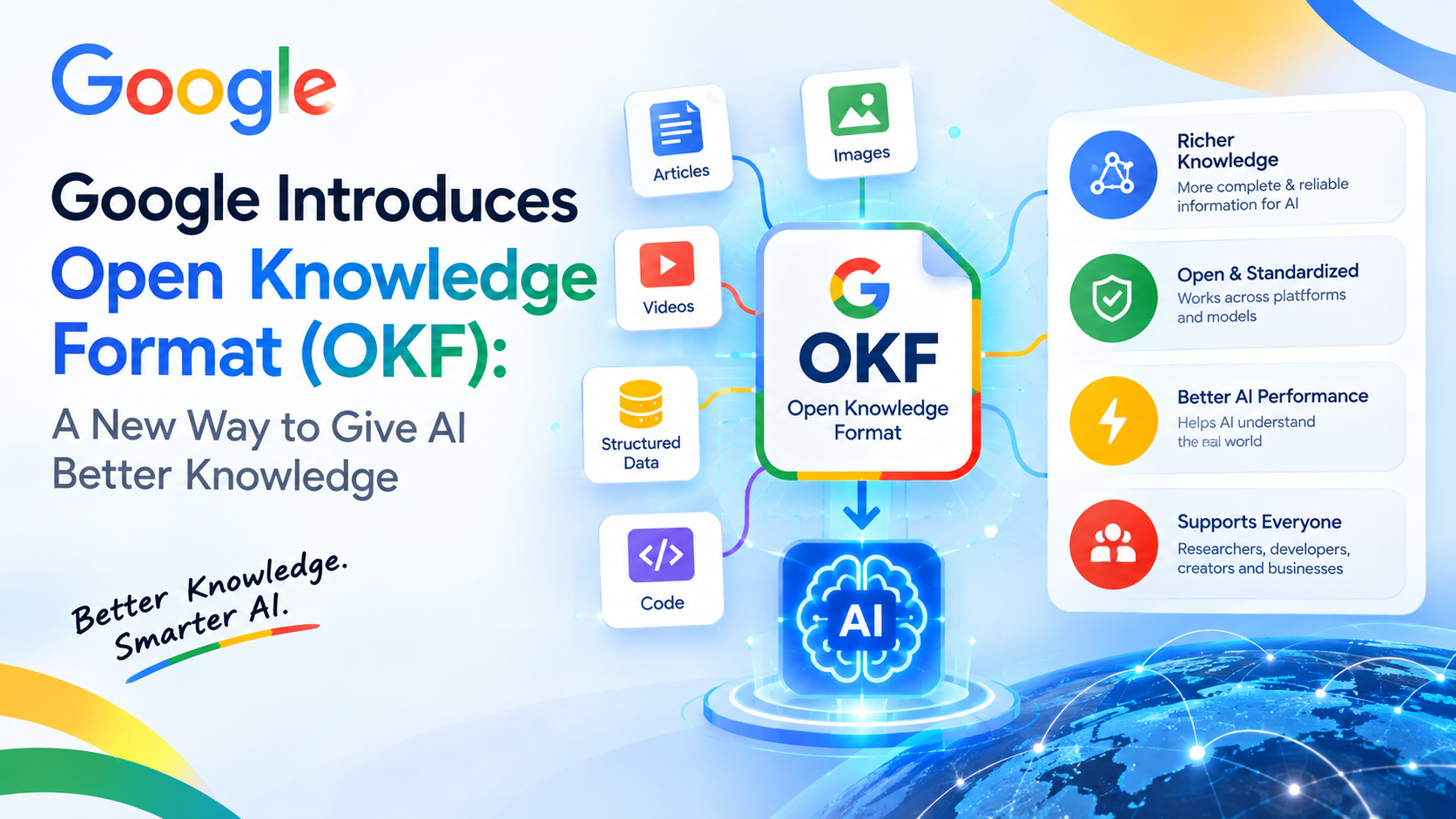
Artificial intelligence models are becoming increasingly powerful, but having a powerful AI model does not automatically mean it has access to the right information. AI agents need accurate context about databases, APIs, business processes, metrics, documentation, and internal systems to complete tasks reliably. To address this challenge, Google Cloud introduced the Open Knowledge Format (OKF) in June 2026, an open specification designed to make knowledge more portable, structured, and accessible to both humans and AI agents.
The idea behind OKF is relatively simple: instead of keeping important knowledge locked inside different proprietary platforms, databases, wikis, dashboards, or scattered documents, organizations can represent that knowledge using a common, open format. The initial OKF v0.1 specification used Markdown files with YAML frontmatter, while the later v0.2 version added trust-related information such as provenance, verification, freshness, lifecycle, and attestation.
What Is the Open Knowledge Format (OKF)?
The Open Knowledge Format, or OKF, is an open specification created by Google Cloud for representing the metadata, context, and curated knowledge surrounding data and systems.
In simple terms, OKF provides a standardized way to package information so that both people and AI agents can understand it. Instead of requiring an AI agent to figure out the meaning of information from a complicated database or a collection of disconnected documents, an OKF knowledge bundle can provide structured descriptions and relationships in a format that is easy to read and process.
1. Why Did Google Create OKF?
One of the biggest challenges facing modern AI agents is not necessarily the lack of intelligence. It is the lack of relevant context. A model may be capable of analyzing a dataset, writing code, or answering a question, but without accurate information about the underlying data and systems, its output may be incomplete or incorrect.
Google Cloud says organizational knowledge is often fragmented across data catalogs, wikis, code comments, dashboards, databases, and the knowledge of individual employees. When every AI application has to reconstruct that context separately, organizations end up creating similar integrations repeatedly. OKF is intended to provide a common layer for representing that knowledge.
2. OKF Uses Simple Markdown and YAML
One of the notable aspects of OKF is that it does not require a complicated proprietary data format. The initial specification represents knowledge as a directory of Markdown files with YAML frontmatter.
Markdown makes the content readable by humans, while YAML provides structured metadata that software can parse. Google describes the format as intentionally minimal, with no required central authority, schema registry, or specialized runtime. This means an organization can create and manage OKF content using familiar development tools and version-control systems.
For example, an organization could create a Markdown file describing a particular business metric. The frontmatter could identify its type, title, description, tags, resource and other metadata, while the body could contain explanations, relationships and relevant knowledge. An AI agent could then consume that information without needing a completely custom integration.
3. OKF Is Designed for AI Agents
AI agents are different from traditional chatbots because they can perform multi-step tasks. An agent might query a database, analyze information, call an API, write code, or execute a business workflow.
To perform these tasks correctly, the agent needs to understand the environment in which it is operating. For example, if an agent is analyzing a company's sales data, it needs to know what different metrics mean, where the data comes from, how it should be interpreted, and which systems are connected to it.
OKF is designed to provide this type of context in a portable format. Google describes it as both human- and agent-friendly, meaning the same knowledge can be consumed by people, AI agents, search systems, visualization tools, or other software.
4. OKF Is Vendor-Neutral
Another important feature of OKF is that it is designed to be vendor-neutral. It is not intended to work only with Google's AI models or a particular agent framework.
The specification can be produced by people, AI agents, export pipelines, databases, documentation systems, or other tools. Similarly, different consumers can use the resulting knowledge bundles. Google's documentation explicitly describes OKF as portable across tools, organizations and time.
This approach could become important as companies increasingly use multiple AI models and agent frameworks. Instead of rebuilding an organization's knowledge layer whenever it changes its AI provider, a standardized knowledge format could allow the underlying context to remain portable.
5. OKF Could Help AI Agents Understand Business Data
Businesses have enormous amounts of data, but raw data alone does not always explain what it means. A database may contain a column called revenue, for example, but an AI agent may need to know whether that figure represents gross revenue, net revenue, monthly revenue, annual revenue, or something else.
This is where metadata and context become important. OKF can describe concepts surrounding data and systems, potentially giving AI agents more information about how those resources should be interpreted.
Google has also demonstrated OKF in connection with its Knowledge Catalog, which can ingest OKF and make the represented knowledge available to agents. This provides an example of how an open knowledge format could connect existing enterprise information with AI systems.
6. OKF v0.2 Adds Trust and Verification Information
The first version of OKF was deliberately simple, but as organizations began considering AI-generated and AI-maintained knowledge, another issue became important: Can an AI agent trust the information it is consuming?
Google's OKF v0.2 introduced additional trust-related concepts, including provenance, verification, freshness, lifecycle and attestation. These features are intended to help consumers understand where knowledge came from, whether it has been verified, how current it is and how it was produced.
This could become increasingly important as AI agents begin creating and updating knowledge themselves. If an agent reads information generated by another agent, knowing its source and verification status can help determine how much confidence should be placed in that information.
7. OKF Could Make Knowledge More Portable
Today, organizational knowledge can become tightly connected to the platform where it was created. A company may have information stored in a data catalog, internal wiki, documentation platform, database or specialized enterprise system.
OKF takes a different approach by representing knowledge as portable files. Google describes the format as something that can be stored in a Git repository, exchanged as a bundle, or consumed by different tools.
This portability could make it easier for organizations to move knowledge between systems. It could also encourage developers to build new tools around the same knowledge bundles, including viewers, search indexes, AI agents and data-processing systems.
8. What Does OKF Mean for the Future of AI?
The introduction of OKF reflects a broader change in AI development. As AI moves toward agentic systems, simply improving the model is not enough. Agents also need access to structured, trustworthy and continuously updated knowledge.
If standards such as OKF gain wider adoption, organizations could eventually create reusable knowledge layers that work across different AI agents and software systems. Developers could focus more on building useful applications while relying on standardized knowledge structures underneath them.
However, OKF is still an evolving specification rather than a universally adopted industry standard. Google introduced v0.1 in June and v0.2 later added trust features, while the open-source project continues to receive proposals and contributions from the community.
How Is OKF Different From a Traditional Database?
A database primarily stores structured data, while OKF focuses on the knowledge and context surrounding data and systems.
For example, a database might contain customer transactions. An OKF bundle could explain what those transactions represent, define relevant business concepts, describe relationships between resources, and provide context that an AI agent needs when reasoning about the information.
OKF therefore does not attempt to replace databases or established technical schemas. Its specification explicitly states that it is not intended to replace domain-specific formats such as Avro, Protobuf or OpenAPI. Instead, it provides a knowledge layer that can reference and explain those systems.
Why OKF Could Matter for AI Developers
For AI developers, the most interesting part of OKF is the possibility of creating interoperable knowledge for AI agents.
As agents become more capable, developers need to solve problems beyond prompting. They need to provide context, connect tools, establish relationships between information, evaluate outputs and maintain trustworthy knowledge.
OKF provides one open approach to this problem. Developers can create producers that convert existing information into OKF bundles and consumers that allow agents or applications to read and reason over those bundles. Google has also published reference implementations and sample bundles to encourage experimentation.
More for your curious side.
Google Gemini 4 Carbon: New AI Model Leads Across Coding, Cybersecurity and Long-Context Benchmarks
Google Gemini 4 Carbon: New AI Model Leads Across Coding, Cybersecurity and Long-Context Benchmarks Google Gemini 4 Carbon is making headlines in the…

Microsoft’s Biggest Exit Offer Ever: 60,000 Employees, Including India
Microsoft has introduced a Voluntary Exit Offer (VEO) that could cover approximately 60,000 employees across the United States, India, the United Kingdom and…

Freshers Read This: IIT Madras Study Says AI Could Shrink Your First Job Options
Every year, lakhs of students in India finish college with one hope: a first job that lets them learn, grow and move up.…