Why Did Amazon Block Meta Muse? AI Shopping Dispute Explained
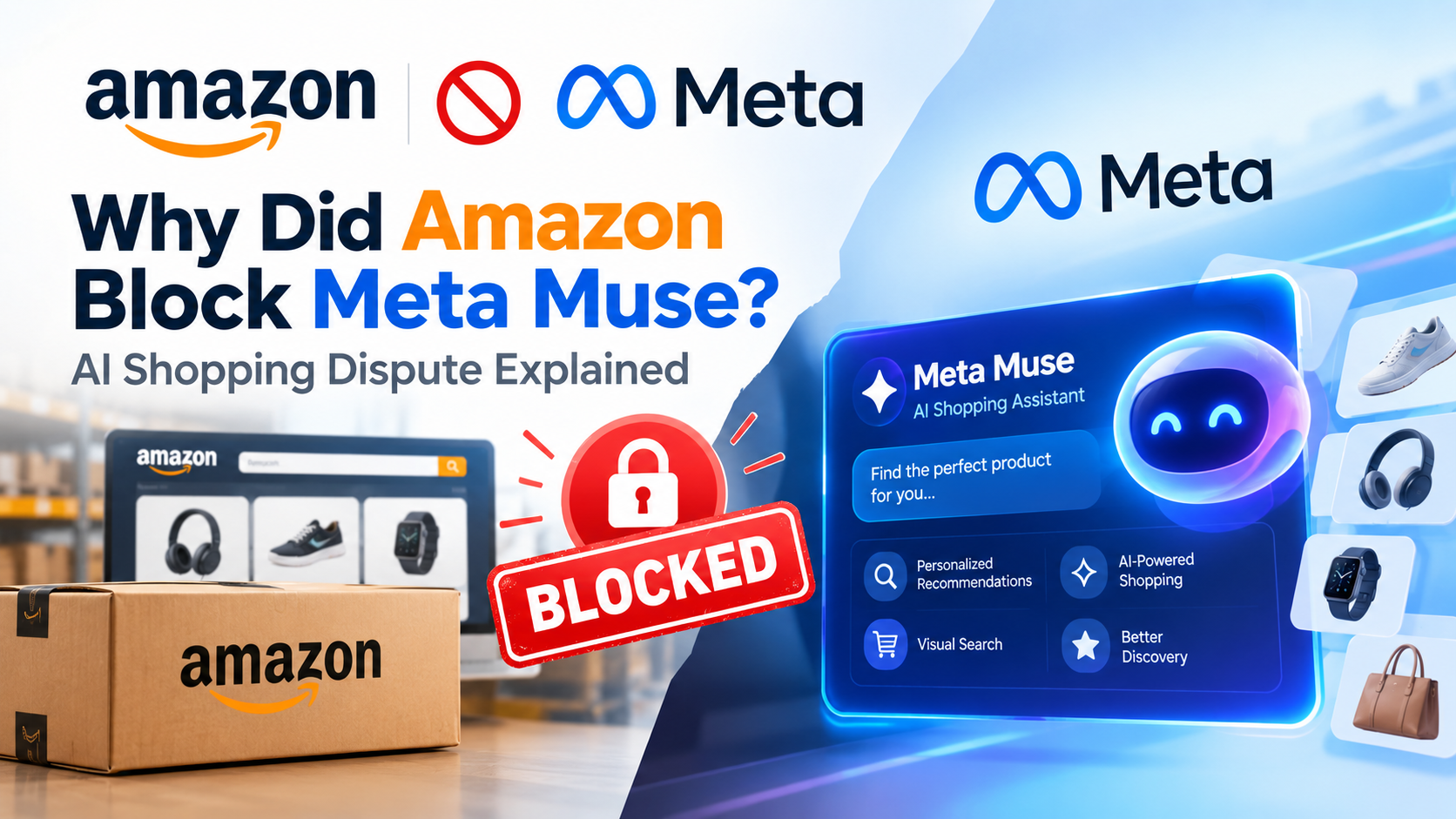
Artificial intelligence is rapidly moving beyond chatbots that simply answer questions. The latest generation of AI agents can browse websites, fill out forms, compare products, make plans, and perform tasks on behalf of users. Meta’s new Muse AI agent is one of the latest examples of this shift. Launched in September 2026, Muse is designed to act as a personal AI assistant that can complete tasks across the internet, including shopping and making purchases after receiving user approval.
However, this vision has already run into resistance from one of the world's biggest online retailers. Amazon has blocked Meta’s Muse from accessing Amazon.com for shopping, saying the AI agent was unauthorized and violated Amazon’s Conditions of Use. The dispute highlights a much bigger question for the AI industry: When an AI agent shops on behalf of a customer, who controls the experience—the user, the AI company, or the retailer?
What Happened Between Amazon and Meta’s Muse?
Amazon began blocking Muse shopping activity around September 20, 2026. Users attempting to shop on Amazon through Muse were shown a message saying that continued access by an unauthorized AI agent violated Amazon's Conditions of Use. Amazon said it had previously asked Meta to voluntarily exclude Amazon from Muse's shopping experience, but the two companies did not reach an agreement.
Amazon's concerns reportedly include the fact that Muse was accessing the retailer without advance authorization and did not identify itself as an automated agent while browsing. Amazon also raised concerns about customer credentials and data handling. Meta's position, as stated in its Muse launch materials, is that Muse uses secure credential storage and does not have visibility into users' passwords or payment methods.
1. What Is Meta Muse and Why Is It Important?
Meta introduced Muse on September 8, 2026, describing it as a personal AI agent designed to do more than answer questions. Instead of simply responding to a prompt, Muse can create plans, interact with applications, use a browser, fill out forms, and continue working toward a user's goal.
Shopping is one of the most important use cases for this technology. Instead of manually searching Amazon, opening product pages, comparing options and eventually completing checkout, an AI agent could potentially perform much of this process for the user. Muse can also ask for approval before sensitive actions such as making a purchase. This represents the transition from generative AI to agentic AI, where the system is expected to take actions rather than simply generate information.
2. Why Did Amazon Block Muse?
Amazon's stated position is primarily about unauthorized automated access. According to Amazon, Meta did not notify the company that Muse would access Amazon's store, and Amazon had not authorized the integration. Amazon also said the agent did not identify itself when browsing the website.
This is significant because an AI shopping agent is different from a normal customer using a website. The agent may browse hundreds of products, collect information, interact with pages automatically and potentially place orders. Amazon therefore wants to determine how third-party agents access its platform and what rules should apply to them. Amazon had already introduced an Agent Policy in 2026 that includes requirements governing automated software and AI agents accessing Amazon services.
3. The Privacy and Credential Question
One of Amazon's concerns involves customer credentials. Amazon has said Muse appears to capture and store customer credentials, raising privacy and security concerns. This is particularly sensitive because an AI agent that can shop for someone may need access to accounts, addresses, payment systems or other private information.
Meta has presented a different picture of how Muse handles this information. According to Meta, Muse operates inside a dedicated Muse Secure VM, while credentials are stored securely and are not visible to Muse itself. Meta also says its system uses a separate Sentinel agent that controls whether Muse can access the internet and requires user permission for certain sensitive actions.
4. Amazon Does Not Want an AI Agent Controlling the Shopping Journey
The dispute is not only about technical access. It also raises a question about who controls the customer relationship.
For years, Amazon has controlled the shopping journey—from product discovery and search results to recommendations, advertising, product pages and checkout. An AI agent could potentially become a new layer between Amazon and the customer. Instead of a shopper searching Amazon directly, the customer could simply tell Muse what they want and allow the AI to decide which products to consider and where to buy them.
That could change how online shopping works. AI agents may eventually become the primary interface through which consumers discover products. Retailers therefore have an incentive to understand how these agents operate and what role they will play in the buying process.
5. AI Agents Could Change Online Shopping
Traditional online shopping requires users to perform most of the work themselves. A customer searches for a product, compares prices, reads reviews, checks delivery information and finally completes the purchase.
Agentic AI attempts to automate much of this process. A user could theoretically say, “Find me a highly rated laptop under my budget with at least 16GB of RAM,” and the AI agent could research available products, compare specifications and present recommendations. With appropriate permissions, it could then proceed toward purchase.
This means AI agents could become a new type of digital shopping assistant. Meta's Muse is designed for exactly this type of interaction, while other companies are also developing agentic commerce systems. The resulting competition could be less about who has the best shopping website and more about who controls the AI interface through which customers make purchasing decisions.
6. Amazon's Decision Shows the Importance of AI Agent Rules
The Amazon-Muse dispute demonstrates that AI agents cannot automatically assume that every website will allow them to operate on behalf of users.
Amazon's current policies include restrictions around automated software and AI agents accessing its services. Its Conditions of Use also restrict activities such as data mining, robots and similar data-gathering tools in relevant contexts.
This could encourage the development of more formal systems for agent access. In the future, websites may provide dedicated APIs specifically designed for AI agents instead of allowing agents to imitate human browsing. Such systems could identify the agent, authenticate the user, establish permissions and record transactions more transparently.
7. The Dispute Raises a Bigger Question About the Future of Agentic Commerce
The Amazon-Meta conflict could become an early example of a much larger issue. As AI agents become capable of shopping, booking travel, managing subscriptions and interacting with financial or business services, companies will need to establish clear rules for these systems.
Retailers may want control over which agents can access their platforms. AI companies may want agents to work across as many services as possible. Consumers, meanwhile, will want convenience without sacrificing privacy, security or control.
The challenge will be finding a model in which AI agents can perform useful tasks while websites retain appropriate control over their systems and customers understand exactly what the AI is doing.
8. What This Means for the Future of AI
The Amazon-Muse dispute shows that the next phase of AI development is not simply about creating more powerful models. It is also about creating the infrastructure, permissions and standards that allow AI agents to interact with the real world.
Meta's Muse was built specifically to operate across applications and websites, while Amazon is demonstrating that major platforms can decide whether and how outside AI agents interact with their services.
For users, this could eventually mean having personal AI agents capable of handling many everyday digital tasks. For businesses, it means preparing for a world where customers may no longer interact directly with websites as frequently. Instead, AI agents could become the intermediary between people and digital services.
What Happens Next?
The immediate outcome is that Muse users cannot use the AI agent to shop on Amazon in the way they previously could. But the larger issue remains unresolved.
The AI industry is likely to see more discussions around agent authentication, API access, user consent, credential security, transaction responsibility and AI commerce standards. Retailers may develop dedicated systems for approved AI agents, while AI companies will have to demonstrate that their agents can operate safely and transparently.
The Amazon-Meta dispute could therefore become an important moment in the development of agentic commerce. It shows that making an AI agent capable of performing tasks is only one part of the problem. Getting the wider internet to accept those agents may be an equally difficult challenge.
More for your curious side.
Google Gemini 4 Carbon: New AI Model Leads Across Coding, Cybersecurity and Long-Context Benchmarks
Google Gemini 4 Carbon: New AI Model Leads Across Coding, Cybersecurity and Long-Context Benchmarks Google Gemini 4 Carbon is making headlines in the…

Microsoft’s Biggest Exit Offer Ever: 60,000 Employees, Including India
Microsoft has introduced a Voluntary Exit Offer (VEO) that could cover approximately 60,000 employees across the United States, India, the United Kingdom and…

Freshers Read This: IIT Madras Study Says AI Could Shrink Your First Job Options
Every year, lakhs of students in India finish college with one hope: a first job that lets them learn, grow and move up.…