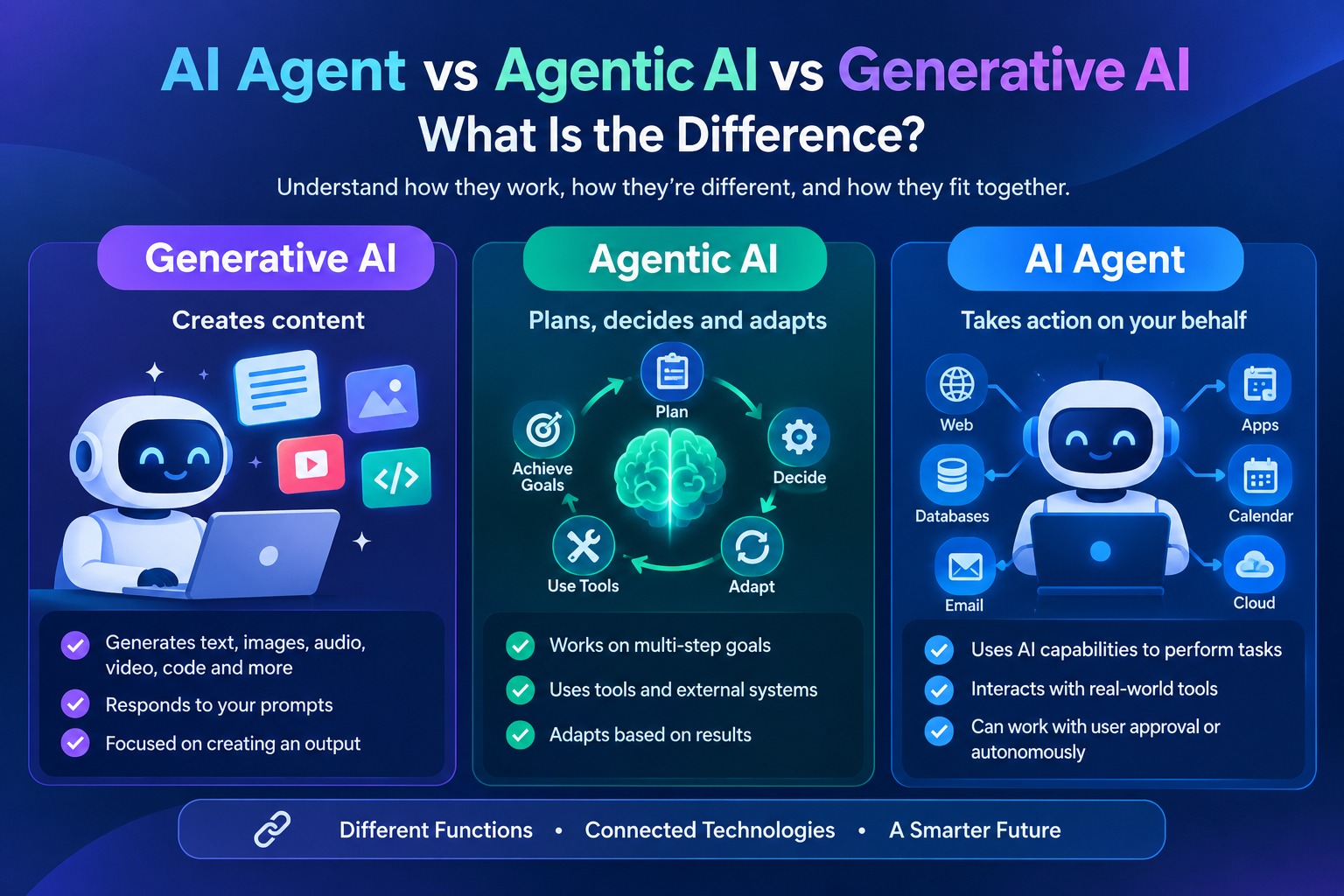
AI Agent vs Agentic AI vs Generative AI : AI Agent vs Agentic AI vs Generative AI explained in simple terms. Learn the key differences, how they work, examples, benefits, use cases, and future of AI.
Artificial intelligence is quickly transcending systems that merely produce responses. These days, terms like “generative AI,” “AI agents,” and “agentic AI” are used in everything from job descriptions, developer platforms, and corporate strategies to technology firms and startups. Despite their similarities, these words refer to distinct facets of contemporary AI systems. For students, developers, job seekers, business owners, and anybody else getting ready for the future of AI, knowing the distinction is becoming more and more crucial.
What Is Generative AI?
Artificial intelligence that can produce new content in response to user commands or other inputs is known as generative AI. Text, pictures, audio, video, software code, presentations, summaries, and other digital output can all be included in that material, depending on the model.
Generative AI-powered tools can produce programming code, compose an essay, draw an image in response to a prompt, summarize a PDF, or respond to inquiries about a subject. Although generative AI encompasses more than just text creation, large language models (LLMs) constitute a significant subset.
What Is an AI Agent?
An AI agent is a system driven by AI that can use tools, observe data, make decisions, and take action in order to achieve a goal. An agent may be able to complete a task by going through several steps rather than quitting after producing an answer.
Consider instructing an AI agent to “choose three hotels for my vacation, analyze their costs and locations, and prepare the best selection for me.” After obtaining the necessary authorization, the agent might search websites, gather data, compare outcomes, arrange the results, and possibly finish a booking.
Action is the key concept. A conventional chatbot might instruct you on how to do a task. An AI agent is intended to assist in carrying out the actual task.
What Is Agentic AI?
AI systems or architectures that are intended to function somewhat independently, pursue objectives, make choices, organize multi-step activities, employ tools, and modify their behavior in response to outcomes are referred to as agentic AI.
For this reason, “agentic AI” is more inclusive than “AI agent.” Rather than necessarily referring to a single software product, it denotes a style or capability of AI activity. Depending on how much planning, autonomy, tool use, memory, and decision-making an AI system possesses, it can display more or less agentic behavior.
Agentic behavior can be seen, for instance, in an AI system that gets a task, divides it into smaller pieces, looks up information, employs software tools, verifies the findings, and modifies its strategy when something goes wrong.
AI Agent vs Agentic AI vs Generative AI: Quick Difference
| Feature | Generative AI | Agentic AI | AI Agent |
|---|---|---|---|
| Main purpose | Generate content | Pursue goals and complete tasks | Perform tasks on behalf of users/systems |
| Creates content | Yes | Often | Often |
| Plans multiple steps | Usually limited | Core capability | Common capability |
| Uses external tools | Sometimes | Common | Common |
| Takes actions | Usually limited | Yes | Yes |
| Works autonomously | Usually limited | Can | Can |
| Memory | May have it | Often useful | Often useful |
| Examples | Text/image/video generation | Autonomous workflows | Research or shopping agent |
The most important point is that these categories overlap. Generative AI can be a component inside an AI agent, while agentic AI describes the broader behavior that allows an AI system to work toward a goal.
1. Generative AI Focuses on Creating, While AI Agents Focus on Doing
Their main goal is the most obvious difference between AI agents and generative AI. The main goal of generative AI is to produce an output. The system responds to your prompt, query, or input. An email, article, picture, video, piece of code, synopsis, or explanation might be that output.
In contrast, an AI agent is made to do more than just provide an output; it may actually carry out a series of actions. A generative AI model might offer recommendations if you ask it to locate flights. An agent might look for flights that are available, compare them based on your preferences, gather the necessary data, and then prepare or finish the following step with the necessary authorization.
Simple Way to Remember
Generative AI = Create
AI Agent = Act
Agentic AI = Goal-oriented behavior that enables AI to plan and act
This is a simplified distinction, but it is useful for understanding the broader ecosystem.
2. Agentic AI Can Plan and Execute Multi-Step Tasks
The ability of agentic AI to go through several steps toward a goal is one of its distinguishing features. An agentic system may decide what needs to happen next, carry out an action, assess the outcome, and proceed rather than reacting once and stopping.
Let’s take an example where you ask an AI system to create a competitive analysis. Based on the data you supply, a basic generative AI system might produce a report. Multiple sources could be searched, data could be gathered, competitors could be compared, findings could be organized, missing data could be found, and a final report could be produced by an agentic system.
This does not imply that all agentic systems are fully independent. Important steps can incorporate human approval, especially when operations involve money, private information, external contact, or irreversible changes.
3. AI Agents Use Tools to Interact With the Real World
Tool utilization is a key feature that sets AI agents apart from other generative AI systems. Web browsers, databases, email, calendars, enterprise software, code execution environments, and other applications can all be linked to an AI agent.
Think about an AI customer service representative. An explanation of an order status can be written by a generative AI model. An AI agent linked to a business’s systems might search for the customer’s order, verify shipping details, pinpoint the issue, and start an authorized action, like amending a support ticket.
AI systems can move from reasoning to action with the help of tools. An AI model can produce instructions or recommendations without the need for tools. An agent can communicate with external systems if they have the right tools and permissions.
4. Generative AI Can Be the “Brain” Behind an AI Agent
AI agents and generative AI shouldn’t be seen as rival technologies. A generative AI model can be an essential part of an agent’s thinking and language in various architectures.
A big language model, for instance, can decipher the user’s request, choose the appropriate tool, provide instructions for that tool, analyze the information received, and assist in determining the next course of action. The tools, memory, orchestration, permissions, and execution environment are provided by the surrounding agent architecture.
This means a sophisticated AI agent can combine several technologies:
Typical AI Agent Architecture
User Goal → AI Model → Planning → Tool Selection → Action → Observation → Reasoning → Next Action → Final Result
Generative AI can therefore be one component of a much larger agentic system.
5. Memory and Context Make AI Agents More Useful
Another key idea in agentic AI is memory. When working on a multi-step process, a system must keep track of what has already happened, what needs to be done, and what information is pertinent.
For instance, when organizing a trip, an AI travel agent might have to keep in mind your destination, dates, spending limit, preferred hotel, transportation needs, and prior choices. Without enough context, the system can ask the same questions over and over again or become distracted from the main goal.
However, an AI system is not automatically an agent just because it has memory. One supporting capability is memory. When memory is combined with skills like planning, using tools, making decisions, providing feedback, and taking action, an agent becomes more agentic.
6. AI Agents Can Operate With Different Levels of Autonomy
Not all AI agents are fully autonomous. There is a range of autonomy. While some systems can carry out multiple processes independently before returning the outcome, others require user consent for nearly every major activity.
A research agent might, for instance, automatically search websites, compile data, and provide a report. Before processing a payment, an agent handling financial transactions, however, may pause and request the user’s consent.
For high-impact applications, this human-in-the-loop strategy is particularly crucial. Increasing the autonomy of an AI system can make it more convenient, but it also makes mistakes more likely to occur.
Examples of Different Autonomy Levels
Low autonomy:
AI suggests what the user should do.
Medium autonomy:
AI performs routine steps but asks for approval before important actions.
High autonomy:
AI independently manages a task within predefined permissions and constraints.
7. Agentic AI Is Becoming Important Across Different Industries
Since many professional processes include repeated, multi-step digital operations, agentic AI has potential applications in nearly every field.
An AI agent may be able to examine a codebase, find a problem, change code, run tests, examine errors, and refine the solution in software development. An agent in marketing might conduct audience research, develop campaign concepts, provide content, evaluate performance information, and suggest next actions.
Examples of Agentic AI Use Cases
- Software development
- Customer support
- Marketing automation
- Sales operations
- Research
- Data analysis
- Travel planning
- Recruitment
- Personal productivity
- IT operations
- Finance administration
- E-commerce
The actual capabilities depend on the specific system, tools, permissions, and safeguards. The existence of an “AI agent” label does not mean every product can perform all of these tasks.
8. AI Agents and Agentic AI Have New Risks
A new class of AI hazards is created by the shift from content creation to autonomous action. While a generative AI model may generate inaccurate data, an AI agent may act upon inaccurate data.
An agent might, for instance, misinterpret user instructions, choose the erroneous product, send the wrong email, alter a database improperly, or follow malicious instructions embedded in a webpage. When agents have access to sensitive data or potent tools, these hazards increase.
As a result, security becomes essential to the development of agentic AI. Permissions, authentication, sandboxing, monitoring, audit logs, human approval, prompt-injection protections, data protection, and failure recovery are all factors that developers must take into account. These precautions grow increasingly crucial when an AI entity gains more autonomy.
What Is the Relationship Between Generative AI, Agentic AI and AI Agents?
Rather than being three distinct categories, these three ideas are better understood as overlapping layers.
Models that can generate content and reason over inputs are made possible by generative AI. Systems intended to achieve objectives through planning, decision-making, tool use, and adaptation are referred to as agentic AI. A concrete system that utilizes these skills to carry out tasks on behalf of a user or another system is known as an AI agent.
A Simple Analogy
Think of an AI system as a human employee.
Generative AI is like the employee’s ability to write, create, explain, and generate ideas.
Agentic AI is like the employee’s ability to plan a project, decide what needs to happen next, and adapt when circumstances change.
An AI agent is like the complete digital worker equipped with those capabilities plus access to tools, applications, data, and permissions needed to perform the work.
This analogy is simplified, but it makes the relationship between the three terms easier to understand.
Examples of Generative AI, Agentic AI and AI Agents
Generative AI Example
You ask:
“Write a LinkedIn post about AI careers.”
The AI generates a LinkedIn post.
The task ends after the content is produced.
Agentic AI Example
You ask:
“Create a campaign to promote our new AI course.”
An agentic system could potentially analyze the objective, determine the required steps, generate content, organize assets, evaluate the results, and adjust the workflow.
The important characteristic is the goal-oriented workflow.
AI Agent Example
You ask:
“Research AI courses, compare them based on price and curriculum, create a shortlist, and send the final comparison to my email after I approve it.”
An AI agent could potentially browse websites, collect information, compare options, draft the email, and wait for approval before sending it.
The system is not merely generating text—it is performing a workflow.
Are AI Agents the Future of Generative AI?
The development of generative AI is increasingly seen to benefit from the use of AI agents. The primary focus of early generative AI applications was content creation, which included text writing, graphic generation, code production, and question answering.
The employment of these models as parts of systems that can achieve more ambitious goals is becoming more and more important in the next phase. Users can increasingly assign procedures and monitor the outcomes rather than relying on AI to produce one output at a time.
This has the potential to drastically alter how users engage with software. Users may eventually specify the desired result and let an AI agent coordinate the required tools instead of launching several apps and manually transferring data between them.
Generative AI vs Agentic AI vs AI Agents: Which One Should You Learn?
Start with generative AI if you’re a newbie or student. A solid foundation is provided by comprehending prompting, huge language models, multimodal AI, AI restrictions, and responsible AI use.
Learn how AI models interact with tools, databases, APIs, retrieval systems, memory, orchestration, and assessment if you work as a developer. These ideas serve as a crucial basis for creating AI bots.
Learning both generative and agentic AI principles can be helpful if you’re getting ready for a career in AI. Businesses are in more need of individuals who not only know how to use AI models, but also how to incorporate them into actual operations.
frequently Asked Questions
What is the difference between Generative AI and AI agents?
Generative AI primarily creates content such as text, images, audio, video, and code. AI agents are designed to use AI capabilities to pursue goals, interact with tools, and perform actions.
What is the difference between Agentic AI and an AI agent?
Agentic AI is a broader term describing AI systems with goal-oriented, autonomous, or semi-autonomous behavior. An AI agent is a specific system or software entity that performs tasks using those capabilities.
Is ChatGPT Generative AI or an AI agent?
ChatGPT is fundamentally a generative AI system, but modern AI assistants can also include agentic capabilities such as tool use, browsing, research, coding, and task execution. Whether a particular experience qualifies as an “AI agent” depends on the capabilities and level of autonomy involved.
Leave a Reply